Travelling with prescription medication abroad without border trouble
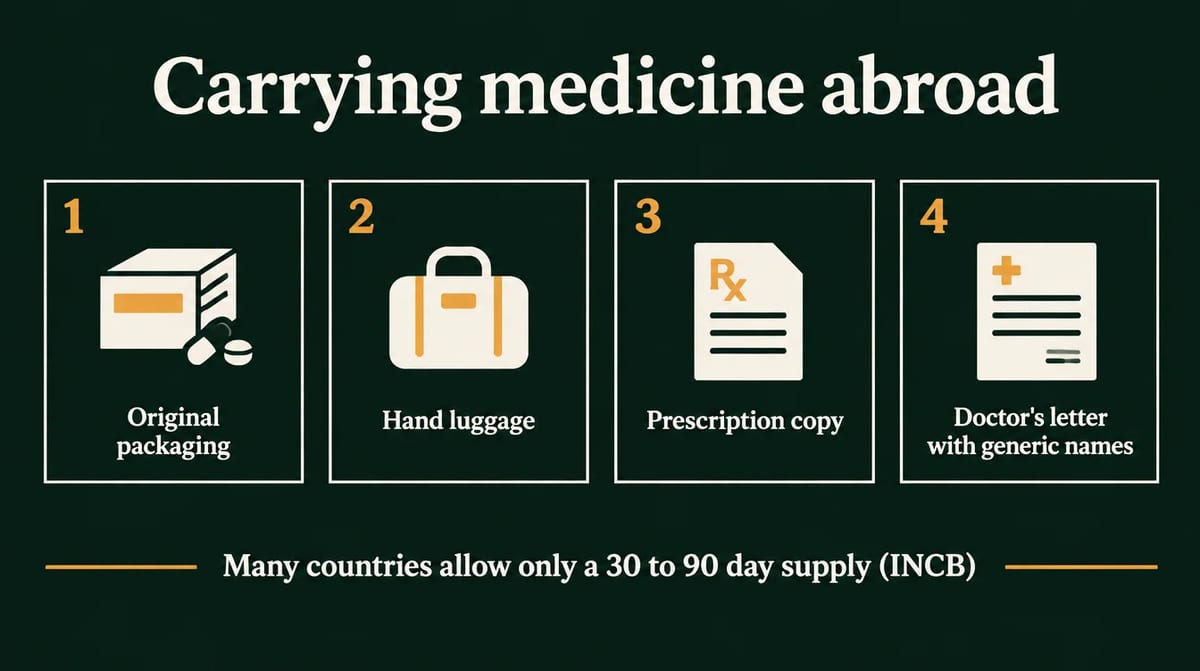
Keep medicine in original packaging in hand luggage, with a prescription copy and a doctor's letter. Check every country on your route, transits included.
On this page (7)
To carry prescription medicine abroad safely, keep it in its original labelled packaging, pack it in your hand luggage, and carry a copy of the prescription plus a letter from your doctor listing each medicine by its generic name. Then check the rules of every country you will enter, including the ones you only change planes in, because a medicine that is ordinary at home can be controlled or banned elsewhere. The US Centers for Disease Control and Prevention warns that breaking those rules can mean confiscation, fines or jail.
- Generic names matter. Brand names change across borders; the active ingredient does not.
- Controlled medicines need the most care: strong painkillers, ADHD medicine, sleeping pills and some cold remedies.
- Your layover counts. The CDC says to check the embassies of countries you transit, not just your destination.
- Take enough for the whole trip plus a buffer, and do not plan to buy it abroad.
The four things every traveller should do
Original packaging, hand luggage, a prescription copy and a doctor’s letter cover most situations for most medicines. Government health advice in the US, the UK and Australia agrees on these basics almost word for word.
| Step | What to do | Why |
|---|---|---|
| Packaging | Keep each medicine in its original pharmacy container, labelled with your name and dose | Proves the medicine is yours and was prescribed |
| Hand luggage | Carry it on board; the UK’s TravelHealthPro suggests some spare in the hold | A lost suitcase should not leave you without it |
| Prescription copy | Carry one, and leave another copy with someone at home | Helps at a border and if you need a replacement |
| Doctor’s letter | List each medicine by generic name, the amount you carry and that it is for personal use | Smartraveller says authorities may ask you to prove it is yours |
| Quantity | Enough for the trip plus extra for delays | Counterfeit medicines are common in some countries, the CDC warns |
The CDC suggests the label show your full name, your prescriber’s name, the generic and brand names and the exact dose, and asks for a letter for any controlled or injectable medicine, such as insulin or an adrenaline auto-injector. Australia’s Smartraveller advises splitting your supply between two bags, so one theft does not take everything.
Start early. The CDC recommends seeing a doctor or travel clinic four to six weeks before departure; Smartraveller says at least eight weeks. That leaves time for a letter, an extra prescription and, if you need one, a permit.
Controlled medicines need extra paperwork
If a medicine contains a controlled drug, check the rules for every country on your route before you fly, and expect to need more than a prescription. The International Narcotics Control Board (INCB), the UN body behind the drug control treaties, says most countries require a prescription from a licensed doctor and many will not let you carry more than a 30 to 90 day supply. Requirements can differ for foreigners, and a country may control substances that are unrestricted where you live.
| Often-restricted medicine | Examples named by official sources |
|---|---|
| Opioid painkillers | Codeine, morphine, fentanyl, methadone |
| ADHD medicines | Amphetamines, Ritalin (methylphenidate) |
| Sleeping pills and sedatives | Diazepam, temazepam |
| Cold and flu remedies | Tablets containing pseudoephedrine |
| Cannabis products | Medical cannabis; CBD, which TravelHealthPro says is banned in many countries |
Sources for the table: Smartraveller’s list of commonly restricted drugs and TravelHealthPro’s examples of UK controlled drugs. Neither list is complete, which is why the next step is always a country-by-country check.
Your home country may have its own rules on the way out. GOV.UK says medicine containing a controlled drug must travel in hand luggage when you enter or leave the UK and can be taken away if you cannot prove it was prescribed; TravelHealthPro adds that carrying about three months’ supply or more of certain controlled drugs needs a Home Office export licence, applied for at least ten days ahead. Australia limits how much Pharmaceutical Benefits Scheme medicine you can take abroad, according to Smartraveller.
The CDC tells travellers to check with the embassies of the countries they connect through as well as their destination. TravelHealthPro specifically warns that even transiting an airport such as those in the UAE with CBD products can have serious consequences. If your flight to Kathmandu changes planes anywhere, that airport’s country counts, so check its rules too.
How to check a country’s rules
Start with the INCB’s country list, then confirm with the embassy of each country on your route. The INCB publishes the regulations governments have sent it, but says plainly that it cannot confirm they are current and that travellers should contact the embassy or consulate.
- Ask your pharmacist or doctor whether any of your medicines contains a controlled substance. GOV.UK points UK travellers to the same question.
- Look up each country on the INCB’s travellers’ page.
- Email or call the embassy or consulate of each destination and transit country, and keep the reply.
- If a medicine is not allowed, ask your doctor about an alternative. Smartraveller and the CDC both suggest this.
Some countries will have nothing listed. When checked on 27 September 2026, the INCB’s entry for Nepal read “Information not yet provided by country”. That is not the same as permission. For Nepal, the embassy route is the only official check, and the paperwork above is your protection.
Altitude medicine and Nepal
If a trek takes you high, ask your doctor about acetazolamide (Diamox) before you leave and carry it with the same paperwork as any other prescription. The CDC Yellow Book tells prescribers to consider it for travellers at medium or high risk of altitude illness, and says Everest Base Camp itineraries push the limits of many people’s ability to acclimatise, with altitude illness approaching 30% at the higher points even on standard schedules.
Two points from the CDC are worth raising with your doctor. Acetazolamide is a sulfonamide derivative, but the CDC says cross-sensitivity with sulfa antibiotics has not been reported, so a sulfa-antibiotic allergy is not automatically a bar; a history of anaphylaxis to any medicine calls for caution. And no pill replaces a sensible ascent. The altitude sickness guide and the acclimatisation guide explain the pacing.
This page gives no doses on purpose. The dose is a decision for the prescriber who knows your weight, your other medicines and your route. The trek first aid kit list covers what else to pack.
Running out or losing medicine abroad
The safest plan is never to need a refill abroad, so pack for the whole trip plus a buffer for delays. The CDC warns that counterfeit medicines are common in some countries and advises using only medicine brought from home. TravelHealthPro cites a 2017 World Health Organization estimate that one in ten medicines in low- and middle-income countries failed quality testing, and notes that a medicine sold under a familiar name abroad can contain a different amount or type of active ingredient.
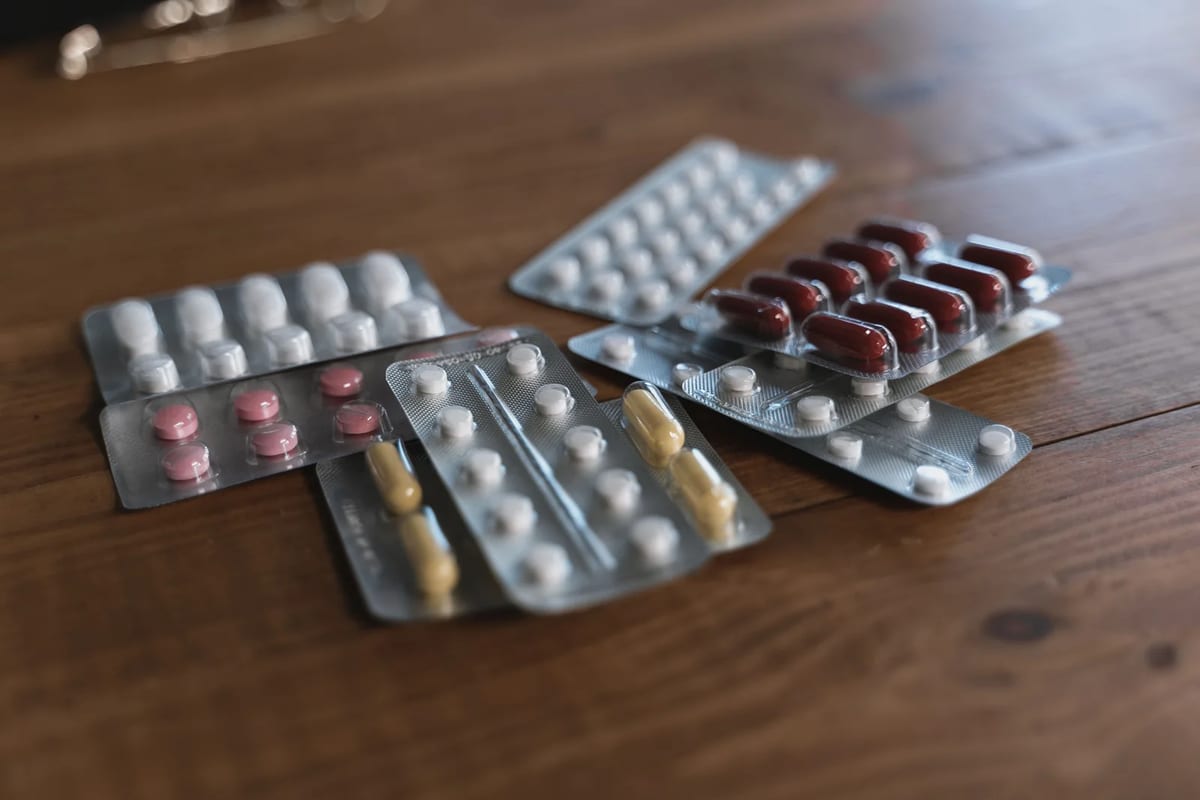
If you do need more, see a doctor or pharmacist rather than buying from a market stall, and show them your letter so they can match the generic name. The FCDO notes that healthcare in Nepal is poor in most places outside the Kathmandu Valley and Pokhara, which is another reason to arrive fully stocked. Crossing time zones? The CDC says to time doses by the hours since your last one, not by the local clock.
The verdict
For most everyday prescriptions, original packaging, hand luggage and a doctor’s letter are enough. For anything controlled, check every country on your route in writing before you book the flights. If a transit airport bans your medicine, change the route or the medicine, not the paperwork.
And be honest with yourself about supply. Buying a replacement abroad is the step that most often goes wrong, and it is the easiest to avoid.
Pack the paperwork, then pick the walk. Annapurna Base Camp is nine days at $920 USD solo and Everest Base Camp is twelve days at $1,700 USD solo, including permits, a government-registered guide, a porter, teahouses and meals.
See the Annapurna Base Camp trek →Do I need a doctor’s letter to travel with medication?
For controlled medicines, usually yes, and it is sensible for any prescription. Smartraveller advises a letter stating what the medicine is, how much you are carrying and that it is for personal use; the CDC recommends one for controlled and injectable medicines.
How much medication can I take abroad?
It depends on the country. The INCB says many countries do not allow more than a 30 to 90 day supply, and the CDC says many allow a 30-day supply of certain medicines with a prescription or medical certificate. Check with the embassy.
Can I put medication in checked luggage?
Keep your main supply in hand luggage. TravelHealthPro suggests some extra in the hold in case your hand luggage is lost, and GOV.UK requires controlled medicines to travel in hand luggage when entering or leaving the UK.
Do transit countries’ medicine rules apply to me?
They can. The CDC advises checking with the embassies of countries you have layovers in, and TravelHealthPro warns that transiting some airports with CBD products can have serious consequences.
Can I take Diamox to Nepal?
Ask your doctor before you travel. The CDC Yellow Book advises prescribers to consider acetazolamide for travellers at medium or high risk of altitude illness. Carry it in its original packaging with your prescription, like any other medicine.
Keep reading
What to carry, and what the lodges will not have.
Which jabs to get, and when to book the clinic.
The pacing that keeps altitude sickness away.
Patches, tablets and the popular fixes that fail.
Sources: US Centers for Disease Control and Prevention, “Traveling Abroad with Medicine”, and CDC Yellow Book 2026, “High-Altitude Travel and Altitude Illness”; International Narcotics Control Board, general information and country regulations for travellers (Nepal entry checked 27 September 2026); GOV.UK, “Take medicine in or out of the UK”, and FCDO Nepal travel advice, health; TravelHealthPro (NaTHNaC), “Medicines and travel”; Smartraveller, “Taking medicine and medical devices overseas”; all read on 27 September 2026. This is general information, not medical advice; speak to a doctor or pharmacist about your own situation.
Photos via Pexels: Towfiqu barbhuiya (cover), 海风 张, Tima Miroshnichenko.
Written by
Anjali ShresthaPokhara-based, NMA-certified trekking guides. We’ve led 5,000+ treks across the Annapurna and Everest regions since 1998 — every word here comes from the trail. More from this author →
Ready to Trek?
From reading about it to standing on it
Our Pokhara-based guides have been doing this since 1998. Tell us your dates and fitness level — we'll build your perfect itinerary. Free, no obligation.
More guides like this
Popular trips to consider
View all treks & toursFree Trekker’s Insider Guide
Permits, packing lists, cost breakdowns — no fluff.
We send one useful email. You can unsubscribe anytime.