
Evacuation membership vs travel insurance and which one your trek needs
Insurance pays medical bills; an evacuation membership pays to move you. A Nepal trek needs insurance first, with an altitude limit above your high point.
On this page (6)
Travel insurance pays your medical bills; an evacuation membership arranges and pays for getting you to a hospital, and usually pays nothing towards treatment. For a Nepal trek you need the first, and the second is an optional extra. The detail that decides whether either works on a trek is altitude. Everest Base Camp sits at 5,364 metres and the Thorong La pass on the Annapurna Circuit at 5,416 metres, while common policy and membership limits sit at 3,000 or 4,600 metres. Buy cover whose number is higher than the highest point you will walk to.
- Insurance first. A membership does not pay a hospital bill in Kathmandu or at home.
- Not all memberships rescue. Some only move you between hospitals once you are admitted.
- Read the altitude number on both, and compare it with your trek’s high point, not its sleeping stops.
- Your credit card is unlikely to be enough for a high trek; check the altitude and evacuation terms before relying on it.
What each one actually pays for
Insurance reimburses costs, including treatment; a membership is a service that transports you and, in the membership’s own words, is not insurance. Global Rescue, one of the best-known field-rescue memberships, says on its own site that it “is not an insurance company” and cannot reimburse members for treatment or trip costs.
| Travel insurance with trekking cover | Field-rescue membership | Hospital-transfer membership | |
|---|---|---|---|
| Medical treatment abroad | Yes, up to the policy limit | No | No |
| Helicopter from the trail | Usually, if medically necessary and approved by the insurer’s assistance team | Yes, within its rules and altitude limit | No; you must already be admitted |
| Flight home to your own hospital | Usually as repatriation, when the insurer judges it necessary | Yes, to a home hospital of your choice when hospitalised far from home | Yes, its core service |
| Trip cancellation, baggage | Often | No | No |
| Example of the type | True Traveller (UK and Europe residents) | Global Rescue | MedjetAssist |
The examples show a type, not a recommendation, and none is linked from this page. The hospital-transfer model is the one people misunderstand. Medjet describes its service as “hospital-to-hospital, bedside-to-bedside”: if you are admitted to a hospital 150 miles or more from home, it arranges transfer to a hospital of your choice in your home country. It does not come up the valley to fetch you.
Why altitude decides everything on a trek
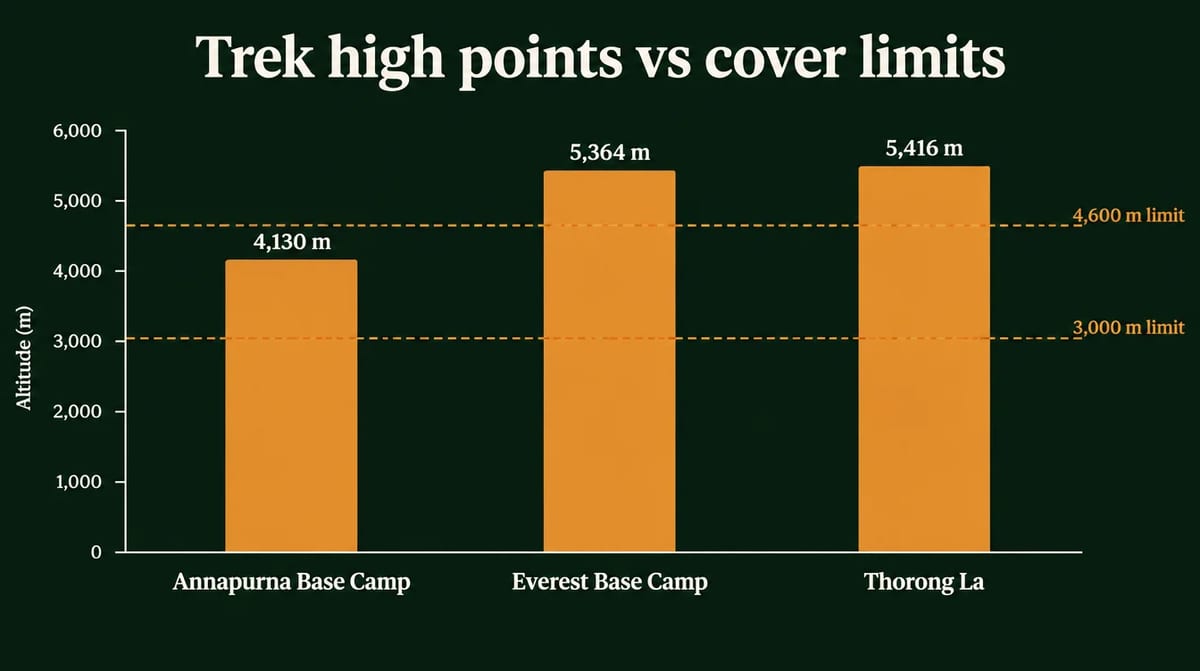
Every policy and membership has an altitude ceiling, and most standard Nepal treks go higher than the cheapest tier. The ceiling is usually written as a single number, and the trek’s highest point is what counts.
| Trek | Highest point | Covered by a 3,000 m limit? | Covered by a 4,600 m limit? |
|---|---|---|---|
| Annapurna Base Camp | 4,130 m | No | Yes |
| Everest Base Camp | 5,364 m | No | No |
| Annapurna Circuit (Thorong La) | 5,416 m | No | No |
| Everest with Gokyo or the Cho La | 5,545 m | No | No |
Those two limits are real, published tiers. True Traveller covers trekking to 3,000 metres as standard, to 4,600 metres with its Adventure Pack, and above 4,600 metres with its Extreme Adventure Pack. Global Rescue’s standard membership stops at 15,000 feet (4,600 metres); above that you need its High-Altitude Evacuation Package, listed at $495 for an individual and $995 for a family, for members aged 16 and over.
Global Rescue’s terms contain the trap every trekker should look for in any contract. If you go above 4,600 metres at any time during the trip, field rescue is not included in a standard membership — even if you are hurt later, lower down. On an Everest Base Camp trek, that means a twisted knee in Namche on the way down is outside the standard membership. The add-on has to be bought before you fall ill or get hurt.
How to read a policy’s altitude and evacuation clause
Find four things in the wording: the altitude number, how the activity is defined, who must approve a rescue, and where they will take you. The marketing page is not the contract; the policy wording is.
- The altitude number. Look for a figure in metres or feet next to “trekking” or “hiking”. If the policy gives none, ask the insurer in writing for one before you buy.
- The activity definition. Trekking and mountaineering are usually priced differently. A trekking peak with ropes, crampons or an ice axe may fall under mountaineering.
- Who approves the rescue. True Traveller, for example, covers helicopter rescue when it is medically necessary and authorised by its emergency medical assistance service. Save that number in your phone and give it to your guide.
- Where they take you. Evacuation normally means the nearest suitable hospital; repatriation means home. They are separate clauses with separate conditions.
Two further checks come straight from the UK government. GOV.UK says to declare pre-existing conditions, because failing to may invalidate the policy, and to make sure the policy covers every activity you plan, since some need specialist cover or an add-on. For Nepal specifically, the FCDO tells travellers to make sure their insurance includes mountain rescue services and helicopter costs.
The FCDO reports isolated cases of guides taking trekkers too high too fast and then calling expensive helicopter evacuations from which they take a cut. A slow itinerary with acclimatisation days protects your health and your claim; our acclimatisation guide explains the pacing, and the helicopter rescue guide explains how rescues are arranged and billed.
Where a credit card fits
Card travel insurance is a bonus, not a trekking policy, and on a high trek it rarely replaces either option above. Check the card’s own terms for an altitude limit, an activity exclusion and an evacuation clause before you count on it. Our guide to the gap in card travel insurance that a trek walks into goes through those clauses, and what card travel insurance actually covers sets out the general picture.
Which one you actually need
Almost every trekker needs travel insurance with trekking cover above their high point; a field-rescue membership is worth adding if you want the rescue run by a dedicated team or your policy’s rescue terms are weak. The right answer depends on who you are, not on which company is best.
- Annapurna Base Camp, or anything under 4,600 metres: a policy with a 4,600-metre tier is enough. A membership is optional.
- Everest Base Camp, the Annapurna Circuit or higher: you need cover above 4,600 metres. If you add a membership, add its high-altitude option too.
- You want to be flown to your own hospital: either membership type does that; check your insurance’s repatriation clause first, because you may already have it.
- You have a pre-existing condition: declare it to the insurer, and read the membership’s exclusions. Global Rescue, for example, lists exclusions including certain infectious diseases and pregnancy beyond the second trimester.
The unprofitable truth: for most people on a standard trek, a membership on top of good insurance buys peace of mind more than new cover. Spend first on the policy tier that covers your altitude.
Your altitude sets your insurance tier, so pick the route first. Annapurna Base Camp is nine days at $920 USD solo, topping out at 4,130 metres; Everest Base Camp is twelve days at $1,700 USD solo, at 5,364 metres. Both include permits, a government-registered guide, a porter, teahouses and meals.
See the Annapurna Base Camp trek →Is an evacuation membership the same as travel insurance?
No. Insurance reimburses costs such as medical treatment. A membership arranges and pays for transport. Global Rescue states that it is not an insurance company and cannot reimburse treatment or trip costs.
Do I need travel insurance for Everest Base Camp?
Yes, and it must cover trekking to at least 5,364 metres. The FCDO advises making sure your policy covers mountain rescue and helicopter costs in Nepal.
Does Medjet cover helicopter rescue in Nepal?
Medjet’s core service is hospital-to-hospital transfer: if you are admitted 150 miles or more from home, it arranges transfer to a hospital of your choice in your home country. It is not described as a rescue from the trail. Check its current terms directly.
What does a 4,600 m altitude limit mean for my trek?
It covers Annapurna Base Camp at 4,130 metres but not Everest Base Camp at 5,364 metres or the Thorong La at 5,416 metres. Under Global Rescue’s terms, going above its limit at any point removes field rescue for the rest of the trip unless you bought the add-on.
Is my credit card travel insurance enough for trekking?
Rarely for a high trek. Check the card’s terms for an altitude limit, activity exclusions and an evacuation clause before relying on it.
Keep reading
The gap in card cover that a high trek walks straight into.
How a rescue is arranged, approved and billed.
The paperwork to collect before you leave the hospital.
The general picture, before you rely on it abroad.
Sources: Global Rescue, travel services page and High-Altitude Evacuation Package FAQs, for what the membership does and does not pay, its 15,000 ft (4,600 m) threshold, add-on prices and exclusions; Medjet, FAQ, for its hospital-to-hospital transfer model; True Traveller, trekking insurance page, for its 3,000 m, 4,600 m and above-4,600 m tiers and rescue authorisation; GOV.UK, “Foreign travel insurance”, and FCDO Nepal travel advice, safety and security; all read on 27 September 2026. Trek high points from our own published itineraries. No provider named here is linked from this page, and none was chosen for commission. This is general information, not financial advice; read your own policy wording before you travel.
Photos via Pexels: Bijay Chaurasia (cover), Sherine, Clinton Weaver.

Written by
Bishnu AdhikariPokhara-based, NMA-certified trekking guides. We’ve led 5,000+ treks across the Annapurna and Everest regions since 1998 — every word here comes from the trail. More from this author →
Ready to Trek?
From reading about it to standing on it
Our Pokhara-based guides have been doing this since 1998. Tell us your dates and fitness level — we'll build your perfect itinerary. Free, no obligation.
More guides like this
Popular trips to consider
View all treks & toursFree Trekker’s Insider Guide
Permits, packing lists, cost breakdowns — no fluff.
We send one useful email. You can unsubscribe anytime.