Most of our Nepal treks climb more than 500 m in a day, and the data says so
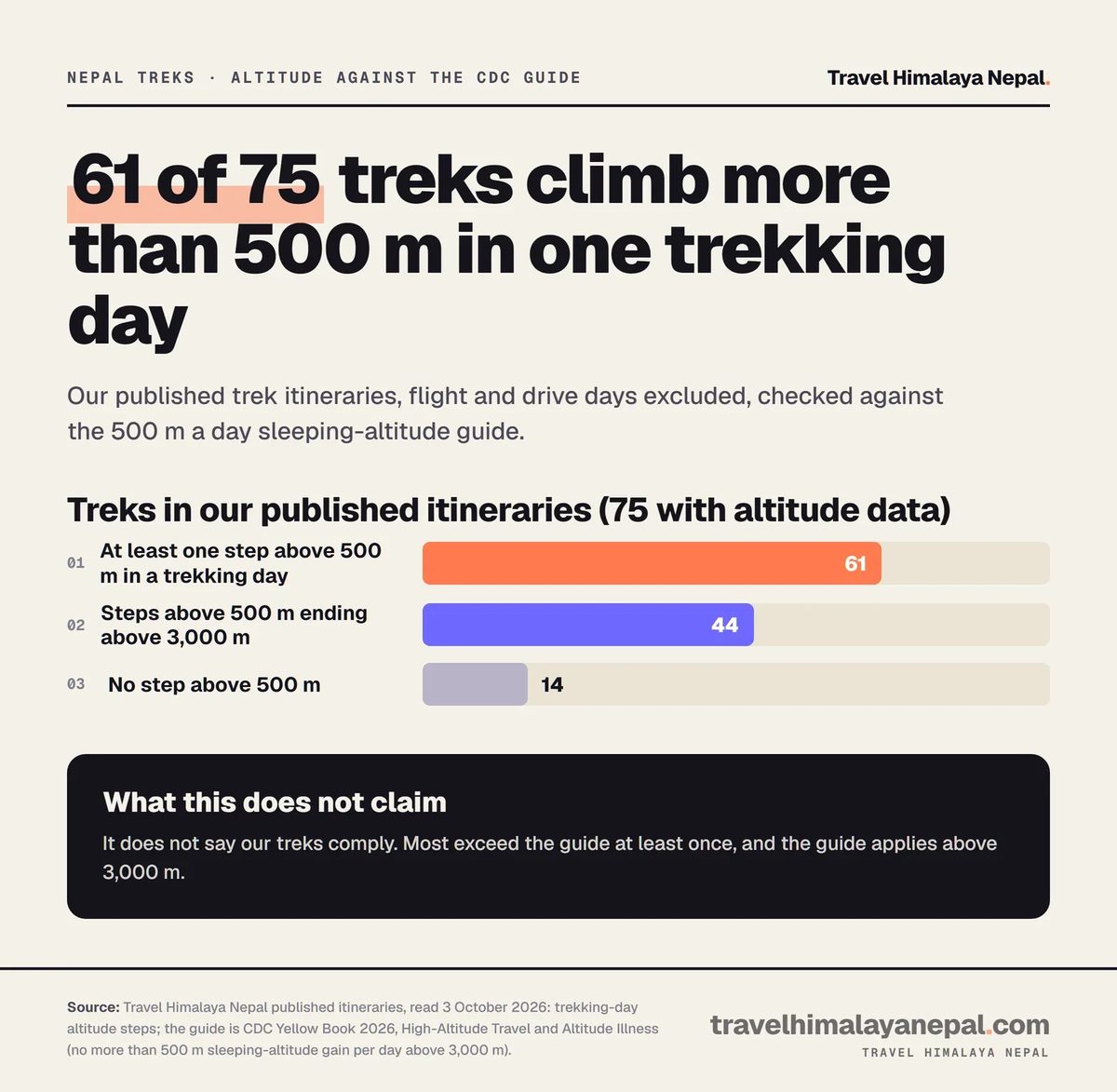
61 of 75 published Nepal treks include a trekking day above 500 m. Our count, the CDC guide, and why a step is not the same as a limit.
 Dawa Sherpa 4 min read
On this page (7)
In our own published itineraries, 61 of 75 treks include at least one trekking day that climbs more than 500 metres, so most of our treks do not meet the 500-metres-a-day guide that medical sources use. The guide says sleeping altitude should rise by no more than about 500 m a day above 3,000 m. Our figures are taken from each itinerary’s altitude field, with flight, drive and rest days left out, and they are a count of what we publish, not a claim that any trek is safe or unsafe.
- Most of our treks break the guide at least once. That is 61 of 75 treks.
- Above 3,000 m, the step matters most. 44 treks have a 500 m-plus step that ends above 3,000 m.
- The median trek reaches about 4,150 m, and the median biggest single trekking-day climb is about 865 m.
- Acclimatisation days are how the guidance is usually applied, so check each trek for them.
What is the 500 m rule, and where does it apply?
Above about 3,000 metres, the CDC advises moving your sleeping altitude up by no more than about 500 m a day, with an extra acclimatisation day for every further 1,000 m. The rule is about where you sleep, not the highest point you walk to on a pass. A day that crosses a pass and returns to a lower camp does not raise sleeping altitude in the same way.
How many of our treks break it?
61 of 75 treks have at least one trekking day that climbs more than 500 m, and 44 have a step of that size that ends above 3,000 m. The biggest single trekking-day climbs in our published itineraries are on the Langtang Gosaikunda trek (about 2,380 m on one day from Thulo Syabru), short Annapurna Base Camp treks (about 1,820 m), and the Annapurna Circuit routes (about 1,670 m). Those figures are what the itinerary lists, and we have not re-surveyed the trails.
Which treks stay within 500 m a day?
14 treks have no trekking-day step above 500 m, mostly short walks at lower altitude. Examples include the three-day Dhampus walk, the three-day Ghandruk walk, the four-day Royal Trek from Pokhara and the Rara Lake trek, where every night is listed at the same altitude. By our own altitude figures, these are not high-altitude treks, though the rule still applies to any step they contain.
Does this mean our treks are unsafe?
No, but a published step is not the same as the step your body takes, and the guidance is a planning target rather than a guarantee. Descent is the treatment for serious altitude illness; see AMS, HACE and HAPE explained for what to watch for.
How do I check a trek’s altitude before I book?
Read the daily altitudes and look for the steps, not just the maximum. Two treks that both top out at 4,500 m can differ widely in how fast they get there. The Everest Base Camp trek (14 days) and the Langtang Gosaikunda trek (13 days) are both listed with their daily altitudes on their tour pages.
We took each trek’s itinerary altitude for every day, removed flight, drive, arrival, departure and free days, and measured the change between consecutive walking days. The altitude field sometimes records a pass rather than the night’s camp, so the steps are approximate. Medical advice is a matter for your own doctor.
Frequently asked questions
What is the altitude rule for trekking?
Above about 3,000 m, do not increase sleeping altitude by more than about 500 m a day, with an extra acclimatisation day for every further 1,000 m, according to the CDC Yellow Book guidance.
How many Nepal treks break the 500 m rule?
61 of 75 treks in our published itineraries have at least one trekking day that climbs more than 500 m.
Which treks stay under 500 m a day?
14 treks in our itineraries, mostly short walks at lower altitude, such as the three-day Dhampus and Ghandruk walks.
Is a 500 m rule a guarantee against altitude sickness?
No. It is a planning guide. Watch for symptoms, rest when needed, and descend if they get worse.
Keep reading
The three altitude illnesses, and what to do.
Prevention, symptoms and treatment.
How many rest days, and where.
Fitness, age and the sleeping-altitude guide.
Sources: Travel Himalaya Nepal published itineraries, read 3 October 2026 (daily altitudes for 75 treks, flight, drive and rest days excluded); CDC Yellow Book 2026, High-Altitude Travel and Altitude Illness, for the 500 m a day sleeping-altitude guidance above 3,000 m. This is general information, not medical advice.
Photos via Pexels: Muhammad Hary (cover), Arjay Neyra, Sujan Kunwar, Lisanne W, Follow Alice.
Written by
Dawa SherpaPokhara-based, NMA-certified trekking guides. We’ve led 5,000+ treks across the Annapurna and Everest regions since 1998 — every word here comes from the trail. More from this author →
Ready to Trek?
From reading about it to standing on it
Our Pokhara-based guides have been doing this since 1998. Tell us your dates and fitness level — we'll build your perfect itinerary. Free, no obligation.
More guides like this
Popular trips to consider
View all treks & toursFree Trekker’s Insider Guide
Permits, packing lists, cost breakdowns — no fluff.
We send one useful email. You can unsubscribe anytime.