
Extreme cold warning vs cold weather advisory, what changed
Wind chill warnings are gone. What an extreme cold warning and a cold weather advisory mean now, how cold each gets by region, and what to do.

On this page (8)
An extreme cold warning means dangerously cold air temperatures or wind chills are expected or already here, cold enough to cause frostbite on exposed skin quickly and hypothermia if you are stuck outside. A cold weather advisory is the step below it: dangerous cold that should stay short of warning level. If you are searching for a “wind chill warning”, it no longer exists. On 1 October 2024 the National Weather Service renamed the wind chill advisory, watch and warning, and dropped the rule that it had to be windy.
The number behind the warning changes with the map. On the Gulf Coast near New Orleans an extreme cold warning starts below 15°F; in northern Minnesota it takes -40°F. Here is the ladder, what the thresholds are where you are going, and what the cold does to a road trip or a day outside.
- Wind chill advisory became cold weather advisory; the wind chill watch and warning merged into the extreme cold watch and warning.
- No wind is needed any more. Still, bitter air can now trigger the same alert as a windy night.
- Thresholds are local. A Louisiana warning and a Minnesota advisory can describe very different numbers, and both are serious where they are issued.
- Frostbite starts with redness or pain, then white or greyish-yellow, waxy or numb skin. Get indoors before it reaches that stage.
What changed when wind chill warnings were retired
The names changed and the wind requirement went, so the alerts now cover still, frigid air as well as wind chill. Service Change Notice 23-44, updated on 26 March 2024, set out the switch for on or about 1 October 2024: the wind chill advisory became the cold weather advisory, and the wind chill watch and warning were folded into the extreme cold watch and extreme cold warning. The hard freeze watch and warning were folded into the freeze watch and warning at the same time.
The practical difference, as NWS Amarillo explains it, is that the old products were based on wind chill and needed a minimum wind speed. Since 1 October 2024 they are issued on the air temperature or the wind chill, with no wind threshold. A calm, clear night at -30°F used to slip through the old definitions. It does not now.
Plenty of pages still explain wind chill warnings as if nothing happened, including TV-station explainers last updated years ago. If a page talks about a wind chill warning in the present tense, it is out of date.
The cold alert ladder
There are three steps, and the Weather Service defines them by how certain and how severe the cold is.
| Alert | NWS definition | Old name | Your move |
|---|---|---|---|
| Cold Weather Advisory | Dangerously cold conditions that are not expected to reach warning criteria | Wind Chill Advisory | Cover all skin, limit time outside, check the car kit |
| Extreme Cold Watch | Extremely dangerous cold or wind chills are possible; occurrence, location or timing still uncertain | Wind Chill Watch | Plan around it: move outdoor days, prepare the car |
| Extreme Cold Warning | Extremely dangerous cold or wind chills are expected or occurring | Wind Chill Warning | Stay inside where you can; drive only if you must |
There is no cold “emergency” product above the warning. Local authorities may open warming centres or close schools on the back of a warning, and those decisions are theirs, not the Weather Service’s.
How cold is an extreme cold warning where you are going?
Anywhere from below 15°F to -40°F, because each office sets its thresholds in tiers that get colder as you go north. NWS New Orleans issues a cold weather advisory south of Interstate 10 when temperatures or wind chills are expected below 25°F, and a warning below 15°F; north of the I-10/12 corridor those become 20°F and 10°F. Around Baltimore and Washington, east of the Blue Ridge, an advisory starts at 0 to -9°F and a warning at -10°F or colder. In the Twin Cities the advisory is -25°F and the warning -35°F; across northern and most of central Minnesota, -30°F and -40°F.
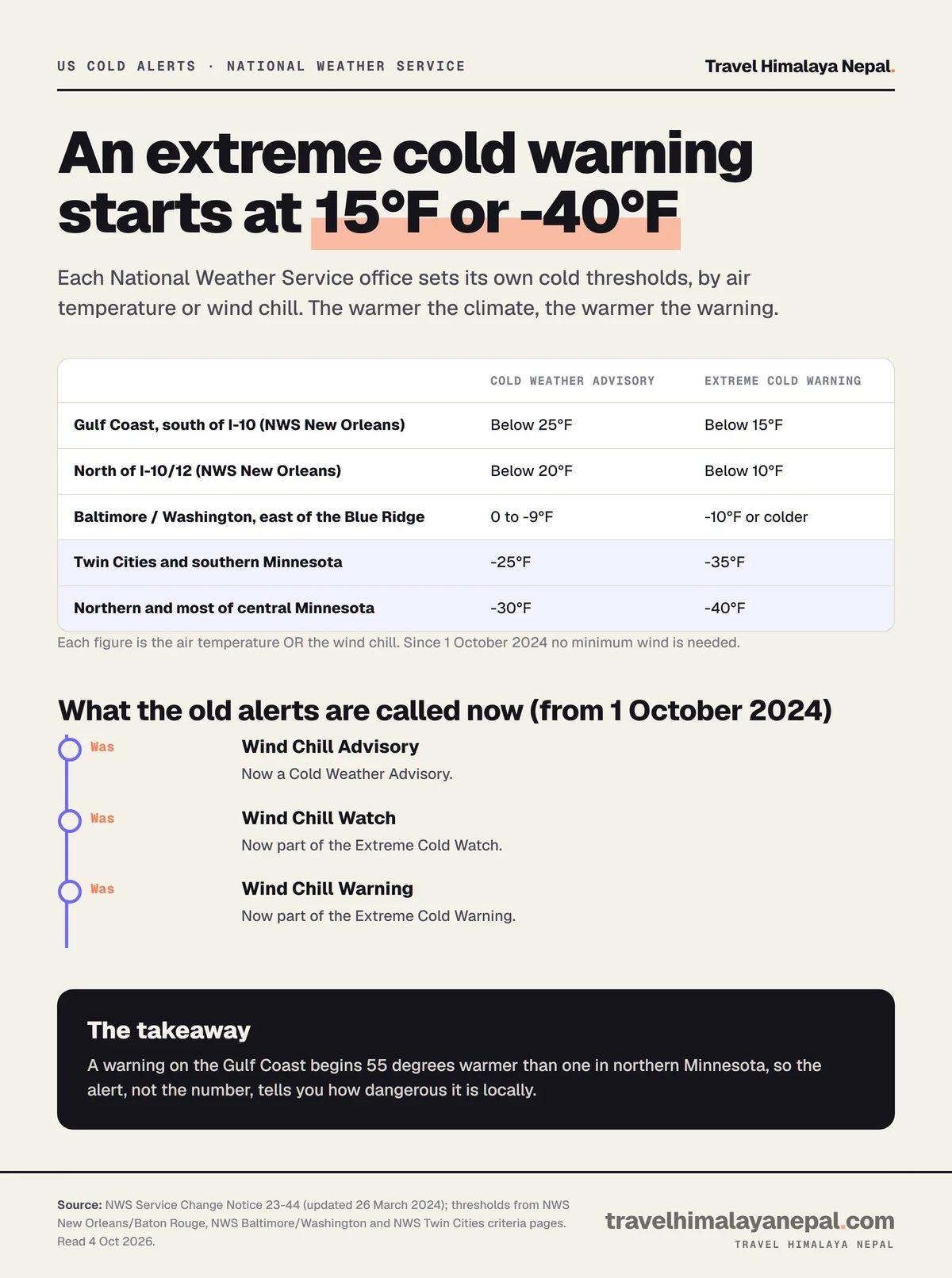
That spread is deliberate. People, homes and pipes on the Gulf Coast are not built for 10°F, so a warning there flags a cold that is dangerous for that place. If you are travelling south for winter sun and see one, take it as seriously as a Minnesotan takes theirs.
Wind chill, explained in one formula
Wind chill is how cold exposed skin feels, and it is only defined at or below 50°F with winds above 3 mph. The Weather Service calculates it as 35.74 + 0.6215T − 35.75(V0.16) + 0.4275T(V0.16), where T is the air temperature in °F and V the wind speed in mph. Its own worked example: at 0°F with a 15 mph wind the wind chill is -19°F, and exposed skin can freeze in 30 minutes.

| Air temperature | Wind | Wind chill |
|---|---|---|
| 10°F | 20 mph | -9°F |
| 0°F | 15 mph | -19°F (NWS example; skin can freeze in 30 min) |
| -10°F | 15 mph | -32°F |
The first and last rows are our arithmetic with the NWS formula, rounded to the nearest degree. One thing wind chill cannot do: freeze something that is above freezing. The Weather Service notes that frostbite needs the actual air temperature near your skin to be below 32°F, whatever the wind chill says.
What extreme cold means for driving and days outside
Plan as if the car could strand you, and keep every inch of skin covered. The CDC lists the early signs of frostbite as redness or pain, then a white or greyish-yellow patch, skin that feels unusually firm or waxy, and numbness. Hypothermia shows up as shivering, exhaustion, confusion, fumbling hands, memory loss, slurred speech or drowsiness, and Ready.gov treats a body temperature below 95°F as an emergency.

- Layer, cover your face and hands, and swap wet gloves and socks straight away. Wet clothing loses its warmth fast.
- Keep the tank full and a kit in the car: blankets, warm clothes, water, snacks, a flashlight, jumper cables and a charged phone, per Ready.gov and the CDC.
- If you are stranded, stay with the car. The Weather Service advises running the engine about 10 minutes an hour for heat, with a window cracked and the exhaust pipe clear of snow to avoid carbon monoxide.
- Never heat a room with a gas stove or oven, and run generators and grills only outdoors, away from windows. Ready.gov is blunt: carbon monoxide is colourless, odourless and kills.
- Shorten the hike or ski day. On a warning day, the miles you would be furthest from the car or lodge are the ones to cut.
Snow usually comes before the deep cold. Our guide to a winter storm watch versus a warning covers the snow and ice alerts, and what a cancelled flight entitles you to.
Our verdict
Read the alert, not the thermometer. The name tells you the local danger: an extreme cold warning on the Gulf Coast at 14°F and one in northern Minnesota at -40°F both mean exposed skin and stranded drivers are at real risk where they are issued. Use the watch to move plans, use the advisory as your cue to cover up, and on a warning day keep outdoor time short and the car kit packed. If you see “wind chill warning” in a forecast or an article, it is out of date; look for the extreme cold warning instead.
From the opposite season, the same Weather Service logic runs our guides to hurricane watches and warnings and the beach hazards statement, the alert that keeps swimmers out of rip currents.
Travelling abroad? We decode other countries’ alerts the same way: the UK’s yellow, amber and red weather warnings, Australia’s cyclone categories and tsunami alerts in the US, Japan and Indonesia.
Frequently asked questions
Is there still a wind chill warning?
No. Since 1 October 2024 the National Weather Service issues an extreme cold warning instead, and the wind chill advisory is now a cold weather advisory.
What temperature is an extreme cold warning?
It depends on the office. It is below 15°F on the Gulf Coast south of I-10, -10°F or colder around Washington, DC, -35°F in the Twin Cities and -40°F in northern Minnesota, measured as air temperature or wind chill.
Is an extreme cold warning worse than a cold weather advisory?
Yes. An advisory covers dangerous cold that should stay below warning criteria; a warning means extremely dangerous cold is expected or occurring.
Does there have to be wind for an extreme cold warning?
No. Since 1 October 2024 the alerts are issued on the air temperature or the wind chill, with no minimum wind speed.
How fast can frostbite happen?
The Weather Service’s example is a wind chill of -19°F (0°F air with a 15 mph wind), at which exposed skin can freeze in 30 minutes. Colder wind chills shorten that.
Can wind chill freeze my car or pipes?
Wind chill itself cannot. Objects only cool to the actual air temperature, so pipes and car fluids freeze when the air is below 32°F, whatever the wind chill. The same goes for skin: frostbite needs the air near it to be below freezing.
Keep reading
The snow and ice alerts, and when to cancel the drive.
The Weather Service surf alert, decoded.
Everything from jet lag to vaccines, in one place.
How our guides layer for nights below freezing.
Sources: National Weather Service Service Change Notice 23-44 (updated 26 March 2024); NWS, Understanding Cold Weather Alerts; NWS Amarillo cold criteria; NWS New Orleans/Baton Rouge, Cold Weather Product Change Overview; NWS Baltimore/Washington and NWS Twin Cities watch, warning and advisory criteria; NWS Wind Chill Chart and formula; NWS, What To Do If You’re Caught in a Winter Storm. CDC, Preventing Hypothermia (frostbite and hypothermia signs) and Preparing for a Winter Storm; Ready.gov Winter Weather. All read 4 October 2026. Wind chills at 10°F/20 mph and -10°F/15 mph are our arithmetic with the NWS formula.
Photos via Pexels: Jola Kedra (cover), Nicolò Pais, freestocks.org.

Written by
Dawa SherpaPokhara-based, NMA-certified trekking guides. We’ve led 5,000+ treks across the Annapurna and Everest regions since 1998 — every word here comes from the trail. More from this author →
Ready to Trek?
From reading about it to standing on it
Our Pokhara-based guides have been doing this since 1998. Tell us your dates and fitness level — we'll build your perfect itinerary. Free, no obligation.
More guides like this
Popular trips to consider
View all treks & toursFree Trekker’s Insider Guide
Permits, packing lists, cost breakdowns — no fluff.
We send one useful email. You can unsubscribe anytime.