
Cyclone categories in Australia and why caravans go first
Australia's five cyclone categories by wind speed, how a Bureau watch differs from a warning, and what to do in a campervan or when flights are cancelled.

On this page (8)
Australia ranks tropical cyclones from Category 1 to 5 by their maximum mean wind speed: a Category 1 averages 63 to 88 km/h with gusts up to 125 km/h, and a Category 5 averages more than 200 km/h with gusts above 279 km/h. Even a Category 1 already damages caravans, and the category says nothing about rain or flooding, which a weak cyclone can still bring. The season runs mostly from November to April, so a summer trip to Queensland, the Top End or northern Western Australia sits inside it.
Two different alerts reach you at the same time: the Bureau of Meteorology’s cyclone watch and warning for the coast, and the state emergency service’s Australian Warning System message telling you what to do. Here is how both work, what each category does, and what to change if you are travelling by campervan or flying out.
- The Bureau names caravans in every category’s damage list from Category 1 up, so a campervan or caravan park is the first place to leave.
- Australian categories are not US hurricane categories. The thresholds and the way wind is measured differ, so do not translate one into the other.
- Watch the Bureau for the weather and your state emergency service for instructions. “Watch and Act” and “Emergency Warning” are what tell you to leave or shelter.
- Ask for a refund, not a credit, if a cyclone cancels your Australian flight.
The five Australian cyclone categories, explained
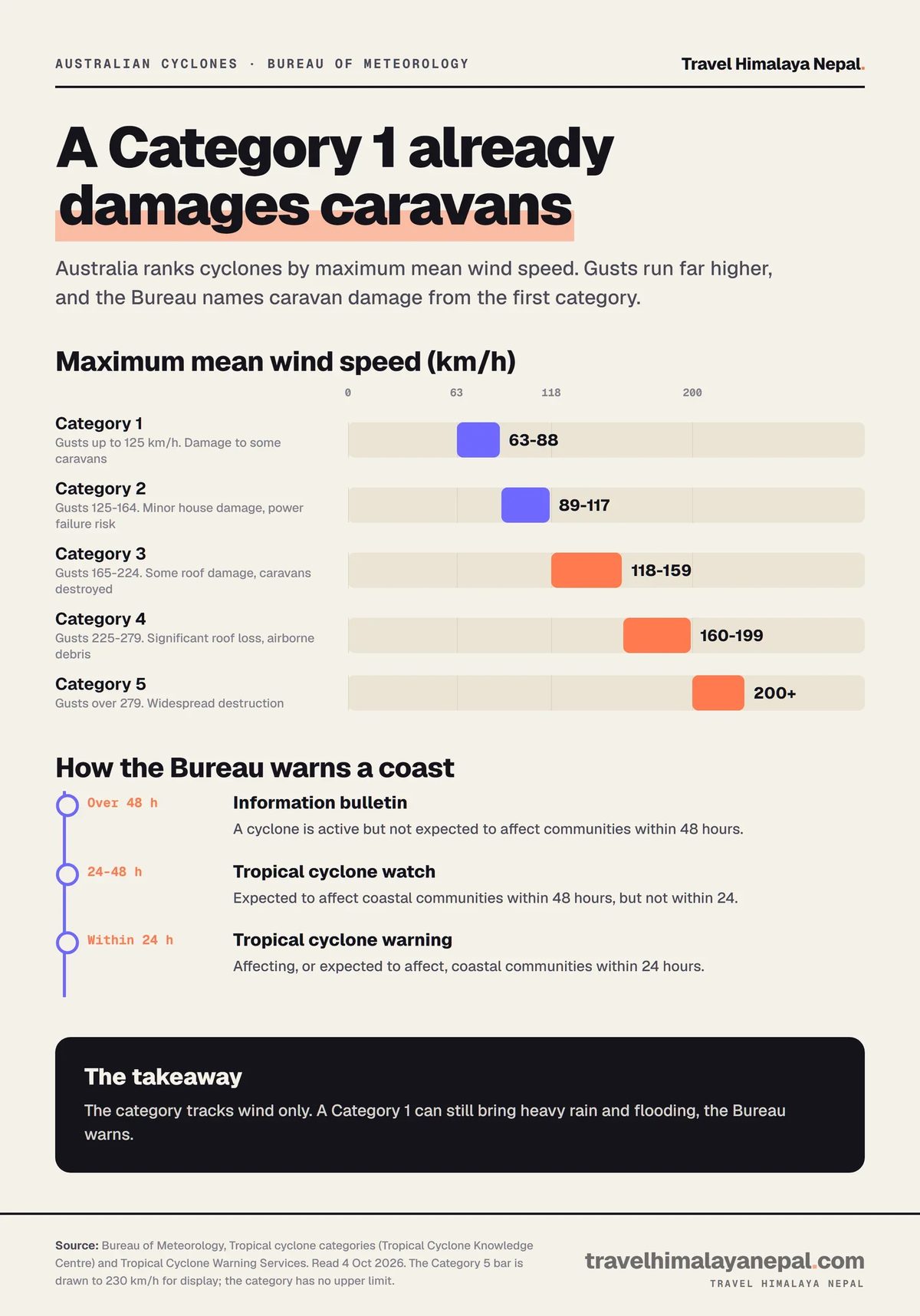
The Bureau grades cyclones by maximum mean wind speed and describes the damage each one does. Its own descriptions are blunt, and caravans appear in four of the five:
| Category | Maximum mean wind | Typical strongest gust | What the Bureau says to expect |
|---|---|---|---|
| 1 | 63–88 km/h | Up to 125 km/h | Damaging winds. Negligible house damage. Damage to some crops, trees and caravans. Craft may drag moorings. |
| 2 | 89–117 km/h | 125–164 km/h | Destructive winds. Minor house damage. Significant damage to signs, trees and caravans. Risk of power failure. |
| 3 | 118–159 km/h | 165–224 km/h | Very destructive winds. Some roof and structural damage. Some caravans destroyed. Power failures likely. |
| 4 | 160–199 km/h | 225–279 km/h | Significant roofing loss and structural damage. Many caravans destroyed and blown away. Dangerous airborne debris. Widespread power failures. |
| 5 | Over 200 km/h | Over 279 km/h | Extremely dangerous, with widespread destruction of buildings and vegetation. |
The Bureau adds a warning of its own: the category “doesn’t indicate the severity of other hazards the cyclone may bring”, and a Category 1 can have significant impact through heavy rain and flooding. For a road trip, the flooded highway after a weak cyclone can strand you longer than the wind.
Why an Australian Category 1 is not a US hurricane
The two scales start at different speeds and measure the wind differently. Australia’s Category 1 begins at a maximum mean wind of 63 km/h. The US Saffir-Simpson scale only starts at 119 km/h (74 mph), measured as a one-minute average, which is the point a storm becomes a hurricane. Some pages online give Australian categories in the US speed bands, or mix up gusts and mean winds. Use the Bureau’s figures for an Australian storm, and see our guide to hurricane watches and warnings for the US system.
Cyclone watch vs warning in Australia
A watch means the cyclone is expected to affect coastal communities within 48 hours but not within 24; a warning means it is affecting them or expected to within 24 hours. Before that, the Bureau issues an information bulletin when a cyclone is active in the region but not expected to affect communities within 48 hours. Its warnings come from three Tropical Cyclone Warning Centres, in Perth, Darwin and Brisbane, and cover the mainland coast plus Christmas Island, the Cocos (Keeling) Islands, Lord Howe Island and Norfolk Island.
Alongside the Bureau, state and territory emergency services issue Australian Warning System messages, which are about what you should do:
- Advice (yellow): an incident is active but there is no immediate threat to lives or homes. Stay up to date.
- Watch and Act (orange): a possible or heightened threat. Take action now, for example prepare to leave, or move and stay indoors.
- Emergency Warning (red): you may be in danger and need to act immediately, for example leave now or take shelter now.
Western Australia moved its cyclone messages onto this system on 15 July 2024 and no longer uses the old Blue Alert, Yellow Alert, Red Alert and All Clear. Older guides that tell you to wait for a “red alert” in WA are out of date.
Travelling by caravan or campervan in cyclone season
Leave the caravan park at the watch, not the warning. Every category from 1 to 4 lists caravan damage, and a vehicle you sleep in is no shelter from the wind or from flying debris.
- Know where the cyclone coast is. Cyclones develop over the tropical waters around northern Australia, mostly from November to April, and the Bureau warns from its centres in Darwin, Brisbane and Perth.
- Move inland or into solid accommodation early. Roads can close with flooding, and the Bureau stresses that rain and flooding come with weak cyclones too.
- Follow the state service, not the category. A Watch and Act or Emergency Warning for your area is the instruction to act, whatever the number on the news.
- Check your hire agreement and insurance. Find out whether your campervan cover excludes cyclone or flood damage, and what the company wants you to do with the vehicle in a warning.
What a cyclone means for flights in Australia
Australia has no fixed delay payout, but if a cyclone means the airline cannot get you there in a reasonable time, the Australian Consumer Law can entitle you to a refund or a replacement flight. As our guide to Australian flight cancellation rights explains, ask for the refund in writing, because a travel credit is the airline’s preference, not your entitlement. When the cause is outside the airline’s control, what you get also depends on your fare conditions, and travel insurance is usually what pays for the extra hotel night.
The Bureau’s warnings cover Norfolk, Lord Howe, Christmas and the Cocos (Keeling) Islands. Islands have few ways off, so if a watch is issued while you are there, talk to your airline and accommodation the same day.
Our verdict
Do not be reassured by a low number. A Category 1 still damages caravans and can flood the roads you need, and the category says nothing about rain. Use the Bureau’s watch as your cue to move, the state service’s Watch and Act or Emergency Warning as your instruction, and a written refund request if your flight is cancelled.
Planning travel in other seasons and countries? We decode the UK’s yellow, amber and red warnings, tsunami alerts in the US, Japan and Indonesia, and the US beach hazards statement the same way.
Frequently asked questions
What is a Category 1 cyclone in Australia?
A cyclone with a maximum mean wind of 63 to 88 km/h and gusts up to 125 km/h. The Bureau describes damaging winds, negligible house damage and damage to some crops, trees and caravans.
What is the difference between a cyclone watch and a cyclone warning?
A watch means a cyclone is expected to affect coastal communities within 48 hours but not within 24. A warning means it is affecting them or expected to within 24 hours.
When is cyclone season in Australia?
Cyclones develop mostly from November to April, over the tropical waters of northern Australia.
Is an Australian Category 5 the same as a US Category 5 hurricane?
No. The scales use different thresholds and measure wind differently. Australia’s Category 5 is a maximum mean wind above 200 km/h with gusts over 279 km/h.
What does Watch and Act mean in a cyclone?
It is the middle level of the Australian Warning System: there is a possible threat to lives or homes and you should take action now, such as preparing to leave.
Will I get a refund if a cyclone cancels my flight in Australia?
Possibly. Under the Australian Consumer Law you may be entitled to a refund or replacement flight; when the cause is outside the airline’s control, your fare conditions also matter. Ask in writing for a refund rather than a credit.
Keep reading
What you can claim when there is no EU-style payout.
How the US system works, and your refund rights.
The US, Japan and Indonesia ladders, side by side.
The UK Met Office colours and the impact matrix.
Sources: Bureau of Meteorology, Tropical cyclone categories (Tropical Cyclone Knowledge Centre) and Tropical Cyclone Warning Services; Australian Warning System level definitions from the WA Department of Fire and Emergency Services and the NSW Government; DFES on the end of WA’s blue, yellow and red cyclone alerts (15 July 2024); National Hurricane Center glossary, for the US hurricane threshold; ACCC flight guidance as summarised in our Australian flight rights guide. All read 4 October 2026.
Photos via Pexels: Marie-Claude Vergne (cover), Eclipse Chasers, Kellie Jane.

Written by
Laxman RawalPokhara-based, NMA-certified trekking guides. We’ve led 5,000+ treks across the Annapurna and Everest regions since 1998 — every word here comes from the trail. More from this author →
Ready to Trek?
From reading about it to standing on it
Our Pokhara-based guides have been doing this since 1998. Tell us your dates and fitness level — we'll build your perfect itinerary. Free, no obligation.
More guides like this
Popular trips to consider
View all treks & toursFree Trekker’s Insider Guide
Permits, packing lists, cost breakdowns — no fluff.
We send one useful email. You can unsubscribe anytime.