
Hurricane watch vs warning, and what it means for your flight
A hurricane watch means 74 mph winds are possible; a warning means they are coming. When each is issued, and your refund rights if flights stop.
On this page (8)
A hurricane watch means hurricane-force winds of 74 mph or more are possible in the area, and the National Hurricane Center issues it about 48 hours before tropical-storm-force winds are expected. A hurricane warning means those winds are expected, issued about 36 hours ahead. For a flight, neither alert cancels anything by itself: the airline does, and if it cancels or badly changes your US flight, you are owed a cash refund if you choose not to fly.
The useful window is the 12 hours between the watch and the warning. That is when airlines tend to post fee waivers, and before the rush for seats out and rooms inland. Below is the full alert ladder, what the categories mean, and what to do with a trip booked into the cone.
- Watch = possible, warning = expected. The timings count back from the arrival of tropical-storm-force winds, not the hurricane itself.
- Storm surge kills more people than wind. A storm surge warning can matter more to a beach hotel than the hurricane category.
- The airline decides about your flight. Change for free under a waiver early; claim the refund if it cancels.
- Evacuation orders come from local officials, not the Hurricane Center. If one covers your hotel, leave.
Hurricane watch vs warning, what each one means
The difference is certainty: a watch says hurricane conditions are possible, a warning says they are expected somewhere in the area. The National Hurricane Center defines both by sustained winds of 64 knots (74 mph) or more. The Weather Service issues the watch 48 hours before tropical-storm-force winds are expected and the warning 36 hours before, because once winds pass 39 mph, boarding up and driving out become hard.

The Weather Service’s advice for a warning is to complete preparations and evacuate if ordered. A watch is your cue to decide whether the trip still makes sense.
The full hurricane alert ladder
There are eight alerts in the hurricane family, and three of them are about water or extreme wind rather than the storm’s category.
| Alert | What it means (NHC / NWS) | Typical lead time | For a traveller |
|---|---|---|---|
| Potential tropical cyclone advisory | A disturbance, not yet a storm, that threatens tropical storm or hurricane conditions on land | Within 72 h | Watch your airline’s travel alerts |
| Tropical storm watch | 39–73 mph winds possible | Within 48 h | Check waivers and plan B |
| Hurricane watch | 74+ mph winds possible | About 48 h before tropical-storm winds | Decide: go early, delay or cancel |
| Storm surge watch | Life-threatening flooding from the sea possible | Generally within 48 h | Beachfront hotel? Plan to move inland |
| Tropical storm warning | 39–73 mph winds expected | Within 36 h | Outdoor plans off |
| Hurricane warning | 74+ mph winds expected | About 36 h before tropical-storm winds | Finish preparations; evacuate if ordered |
| Storm surge warning | Life-threatening flooding from the sea expected | Generally within 36 h | Leave low-lying areas when told |
| Extreme wind warning | Sustained winds of 115 mph or more, usually the eyewall | Within 1 h | Shelter in an interior room now |
Hurricanes have no separate “emergency” alert; the extreme wind warning is the top of the ladder. Inland, the flood alerts take over, and a flash flood warning or emergency from the local Weather Service office can follow the storm for days.
Category 1 to 5, and the danger the scale leaves out
The Saffir-Simpson category measures sustained wind only, from 74 mph for a Category 1 to 157 mph and above for a Category 5. Categories 3 to 5 are “major” hurricanes. The Hurricane Center is explicit that the scale does not account for storm surge, rainfall flooding or tornadoes, and that hurricanes of every category can produce all three.
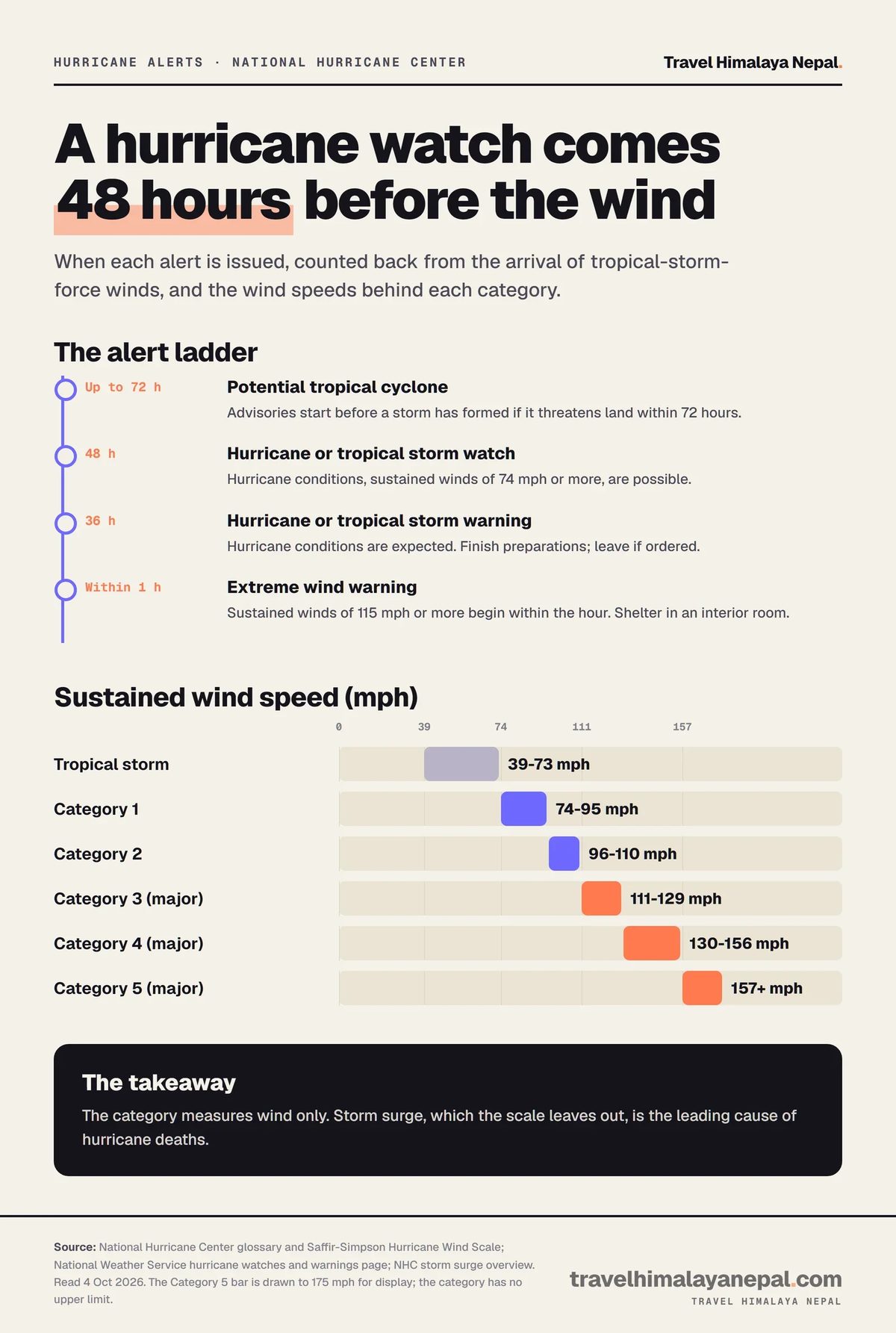
That matters because the Center calls storm surge “the leading cause of fatalities from hurricanes”. A Category 1 that pushes the sea into a beachfront strip can be deadlier for a hotel guest than a stronger storm that comes ashore somewhere empty. Ready.gov’s numbers explain why water is the killer: six inches of fast-moving water can knock you down, and one foot can sweep a car away.
What a hurricane watch or warning means for your flight
An alert is not a cancellation, so you get a refund only if the airline cancels or significantly changes the flight. Under US rules (14 CFR Part 260) you are owed a full cash refund for a cancelled flight, or for a significant change you do not accept, which includes a departure moved three hours or more on a domestic itinerary or six hours or more internationally. Card refunds are due within 7 business days and other payments within 20 calendar days. If you simply decide not to go while the flight still operates, the fare rules on your ticket apply.

That is why the watch is the moment to act:
- Look for a travel waiver. Airlines are not required to offer one, but they often post them when a storm threatens their airports. When Hurricane Nolo approached Hawaii, four airlines waived fees, and each covered something different. A waiver lets you move dates free before the cancellations start.
- Check the airport, not only the airline. The FAA’s National Airspace System status page (nasstatus.faa.gov) shows ground stops and delays at US airports.
- Do not expect a hotel or meals for weather. The care airlines commit to covers delays they cause, not storms. Our flight rights guide sets out what each country requires, and when an airline must rebook you on another carrier.
- Read your travel insurance now. Find the “foreseeable event” clause and the date it treats a storm as known. What decides a claim is usually when you bought the policy, not when you cancelled. Our guide to card travel insurance covers what card cover leaves out.
Follow local evacuation orders, not the airline app. The Weather Service says to evacuate if ordered and, during an extreme wind warning, to shelter in the interior of a well-built structure. Never drive or walk through floodwater.
When is hurricane season, and when is it riskiest?
The Atlantic season runs from 1 June to 30 November and peaks around 10 September, with most activity from mid-August to mid-October. The eastern Pacific season, which matters for Mexico’s Pacific coast, runs from 15 May to 30 November and peaks in late August; the central Pacific, which covers Hawaii, runs 1 June to 30 November. A trip in those windows is not a bad idea, but it is one where you buy insurance at booking and pick a ticket you can change.
Our verdict
Use the watch, do not wait for the warning. At the watch stage you still have free changes, open seats and inland hotel rooms; at the warning stage you have a queue. If you are already on the coast, the storm surge alerts and local evacuation orders matter more than the category on the news. And if your flight is cancelled, take the cash refund rather than a voucher unless the voucher genuinely suits you.
The same Weather Service family runs the alerts for every season: see our guides to a winter storm watch versus a warning, the extreme cold warning, and the beach hazards statement that often follows a passing storm with dangerous surf.
Travelling abroad? We decode other countries’ alerts the same way: the UK’s yellow, amber and red weather warnings, Australia’s cyclone categories and tsunami alerts in the US, Japan and Indonesia.
Frequently asked questions
What is the difference between a hurricane watch and a hurricane warning?
A watch means hurricane conditions, sustained winds of 74 mph or more, are possible and is issued about 48 hours before tropical-storm-force winds. A warning means they are expected and is issued about 36 hours before.
Will my flight be cancelled during a hurricane warning?
Not automatically. Airlines and airports decide. Check your airline for a travel waiver and the FAA’s National Airspace System status page for your airport.
Do I get a refund if a hurricane cancels my flight?
On a US flight, yes: a full cash refund if the airline cancels or significantly changes the flight and you choose not to travel. Weather does not entitle you to meals or a hotel.
What is a storm surge warning?
A warning of life-threatening flooding from rising water moving inland from the shoreline, generally within 36 hours. Storm surge is the leading cause of hurricane deaths.
What is an extreme wind warning?
An alert that sustained winds of 115 mph or more, usually in the eyewall of a major hurricane, are expected within an hour. Take shelter in an interior room of a well-built building.
When does hurricane season end?
The Atlantic, eastern Pacific and central Pacific seasons all end on 30 November. The Atlantic peak is around 10 September.
Keep reading
What airlines really owe you after a cancellation.
The surf alert that follows a passing storm.
The snow and ice alerts, and when to cancel the drive.
Why wind chill warnings no longer exist.
Sources: National Hurricane Center glossary, Saffir-Simpson Hurricane Wind Scale, storm surge overview and tropical cyclone climatology; National Weather Service, Hurricane and Tropical Storm Watches and Warnings; Ready.gov Hurricanes; FAA National Airspace System status; 14 CFR Part 260 (eCFR). All read 4 October 2026.
Photos via Pexels: Asaad Alabri (cover), Guilherme Christmann, Waldemar Brandt.

Written by
Anjali ShresthaPokhara-based, NMA-certified trekking guides. We’ve led 5,000+ treks across the Annapurna and Everest regions since 1998 — every word here comes from the trail. More from this author →
Ready to Trek?
From reading about it to standing on it
Our Pokhara-based guides have been doing this since 1998. Tell us your dates and fitness level — we'll build your perfect itinerary. Free, no obligation.
More guides like this
Popular trips to consider
View all treks & toursFree Trekker’s Insider Guide
Permits, packing lists, cost breakdowns — no fluff.
We send one useful email. You can unsubscribe anytime.