
Tsunami warning vs advisory vs watch, and when to run
A tsunami warning means flooding, an advisory means dangerous water, a watch means maybe later. How the US, Japan and Indonesia differ, and what to do.
On this page (7)
In the United States a tsunami warning means widespread coastal flooding is expected, so move to high ground or inland now. A tsunami advisory means strong currents and waves are dangerous to anyone in or near the water, so get out and stay off the beach. A tsunami watch means a tsunami may reach the area later, usually after a distant earthquake, so stay tuned and be ready to move. In Japan and Indonesia the names and the order differ, and the second level already means evacuate.
That difference is what catches travellers. An American who reads “tsunami warning” on a Japanese screen may think it is the top alert; it is the middle one. Below is each country’s ladder, the natural signs that can beat every alert, and what to do on a beach, in a hotel or on a cruise.
- A strong or long earthquake on the coast is your warning. Do not wait for a siren or a phone alert; head for high ground.
- An advisory is not a non-event. Even without flooding, the currents can drown swimmers and capsize small boats.
- The first wave may not be the last or the largest. Stay away until officials say it is safe.
- In Japan, install the Safety tips app. It pushes tsunami warnings in English and 14 other languages.
Tsunami warning vs advisory vs watch in the US
Warning means flooding, advisory means dangerous water, watch means maybe later. The National Tsunami Warning Center defines a tsunami warning as a tsunami “with the potential to generate widespread inundation” that is imminent, expected or occurring, with the action “move to high ground or inland”. A tsunami advisory covers a tsunami that can generate strong currents or waves dangerous to people in or very near the water; the action is to stay out of the water and away from beaches and waterways.
A tsunami watch means a tsunami may later affect the watch area, and the action is to stay tuned and be prepared to act. Below those sits the information statement: an earthquake or tsunami has happened that is of interest, but no action is suggested. A watch is often upgraded or cancelled within hours, as the centres measure the actual waves.
How Japan and Indonesia name their tsunami alerts
Both countries put evacuation at their middle level, and both grade alerts by the expected height of the waves. The Japan Meteorological Agency issues a Major Tsunami Warning when the tsunami is expected to exceed 3 metres, a Tsunami Warning for up to 3 metres, and a Tsunami Advisory for up to 1 metre. For both warnings its instruction is to evacuate coastal and river areas immediately to high ground or a tsunami evacuation building. For an advisory it is to get out of the water and leave coastal areas. JMA aims to issue them about three minutes after the earthquake, sometimes two, and since 30 August 2013 a Major Tsunami Warning has been classed as an Emergency Warning.
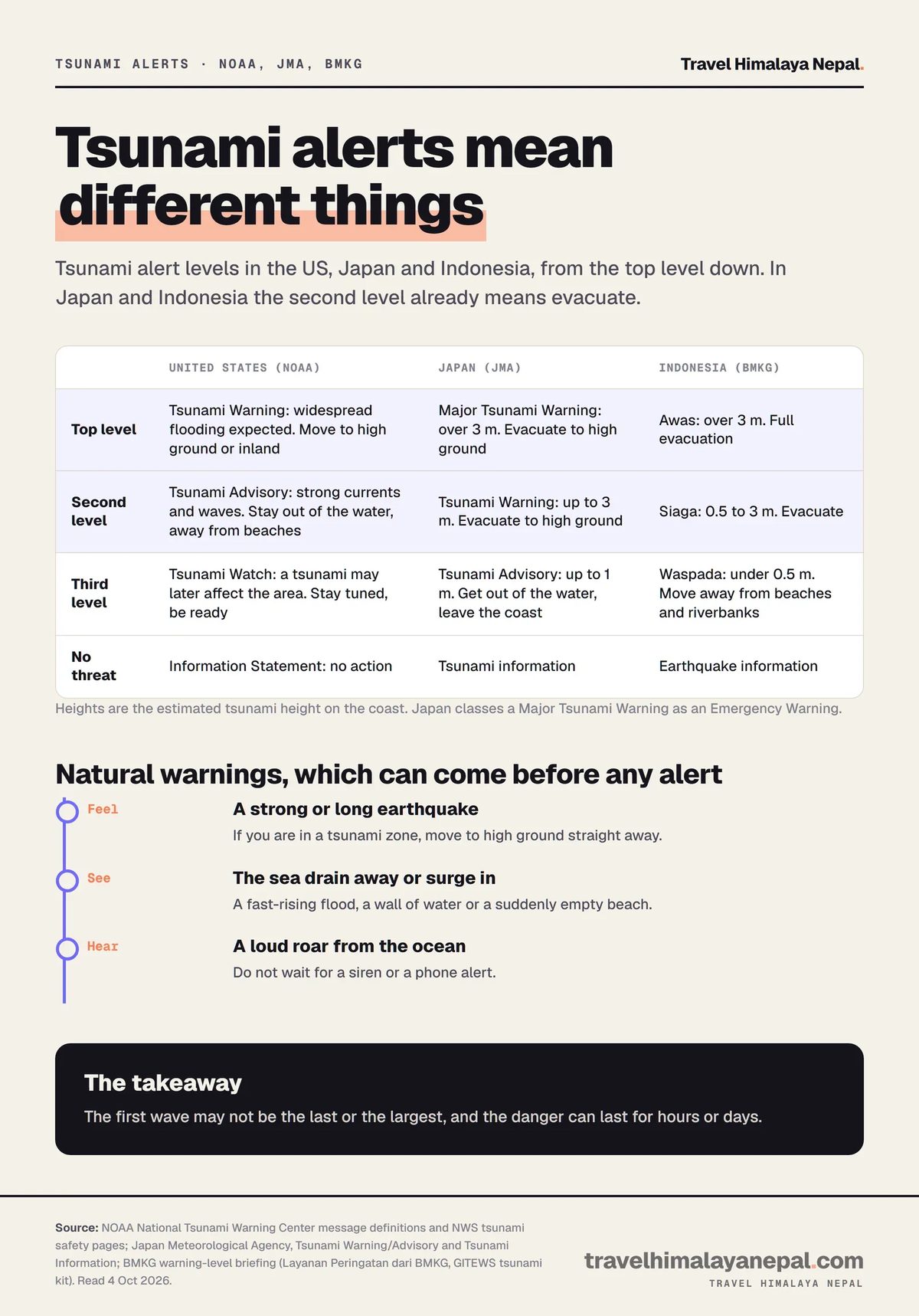
Indonesia’s agency, BMKG, uses three local-language levels. Awas is for an expected height above 3 metres and calls for full evacuation. Siaga covers 0.5 to 3 metres and calls for evacuation. Waspada is under 0.5 metres and tells local governments to move people away from beaches and riverbanks. If you are in Bali or Lombok and hear “siaga”, leave the beach and go uphill.
| Level | United States | Japan | Indonesia |
|---|---|---|---|
| Top | Warning: widespread flooding; move to high ground or inland | Major Tsunami Warning: over 3 m; evacuate | Awas: over 3 m; full evacuation |
| Second | Advisory: dangerous currents; leave the water and beach | Tsunami Warning: up to 3 m; evacuate | Siaga: 0.5–3 m; evacuate |
| Third | Watch: may affect the area later; be ready | Tsunami Advisory: up to 1 m; leave the water and coast | Waspada: under 0.5 m; move away from beaches and riverbanks |
| No threat | Information statement | Tsunami information | Earthquake information |
The natural warning signs that beat every alert
If the ground shakes hard or long, or the sea behaves strangely, go to high ground without waiting for an official warning. The Weather Service lists three signs: a strong or long earthquake; the ocean acting strangely, such as a fast-rising flood, a wall of water, or the water draining away suddenly; and a loud roar from the ocean. Move as high, or as far inland, as you can.
Two more rules from the same guidance matter for visitors: the danger may last for hours or days, and the first wave may not be the last or the largest. People who go back to the beach to look, or to collect their things, are walking into the second wave.
What to do on a beach, in a hotel or on a cruise
Know your way to high ground before you need it, and follow local officials, not social media.
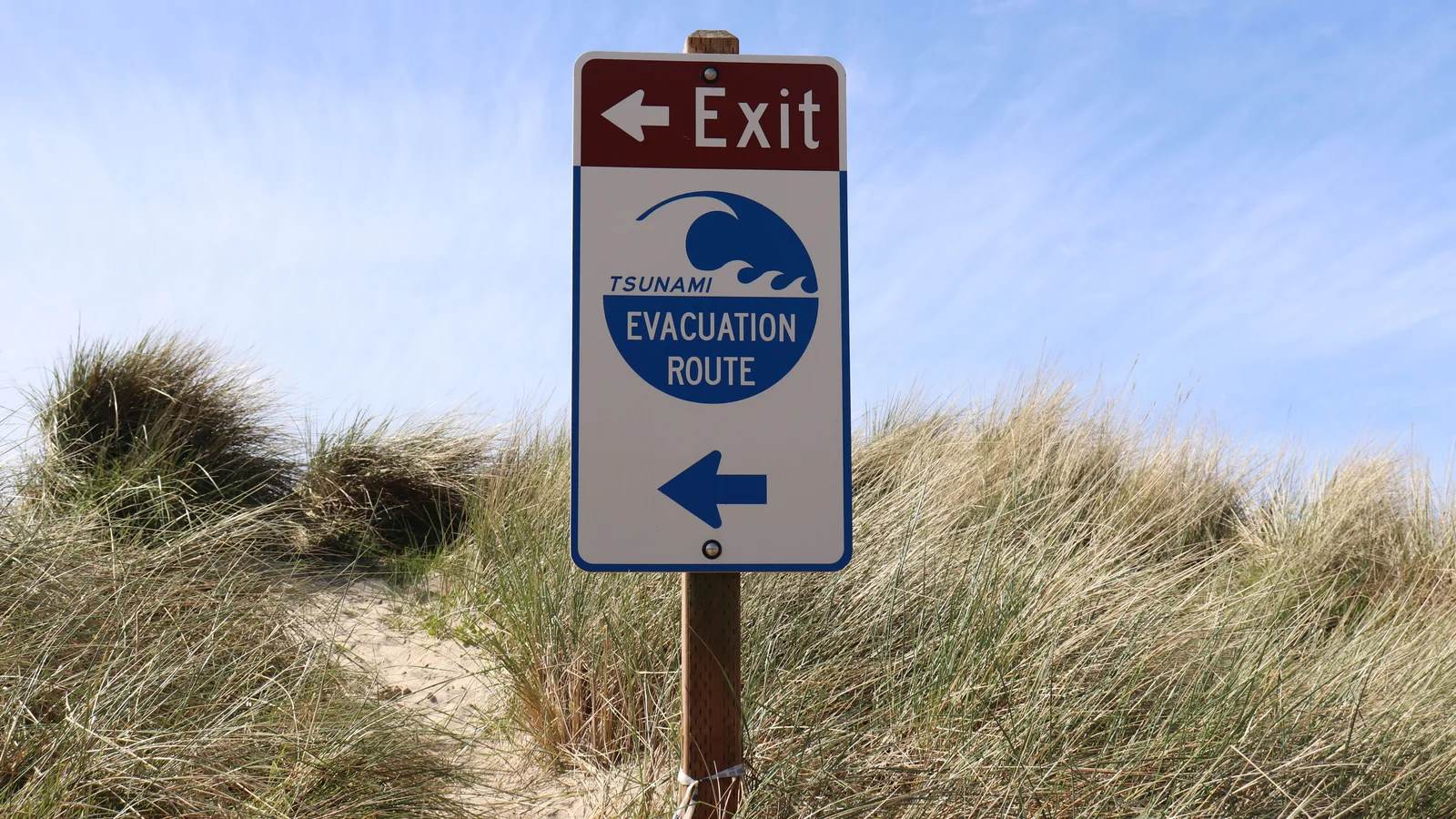
- On the beach: under a US advisory or a Japanese advisory, leave the water and the shore. Under any warning, or Indonesian siaga or awas, go uphill or inland on foot. Follow the tsunami evacuation route signs where they exist, like the one in our photo from the Oregon coast.
- In a hotel: ask at check-in whether the building is in a tsunami zone and where the evacuation route goes. In Japan, the instruction for both warning levels includes moving to a designated tsunami evacuation building if high ground is too far.
- On a cruise: follow the crew and port authority instructions. If you are ashore when a warning is issued, go to high ground with everyone else rather than back to the pier.
- In Japan: the Japan National Tourism Organization’s Safety tips app pushes earthquake early warnings and tsunami warnings in 15 languages, including English, with an evacuation flowchart.
- Driving: if you can walk to safe ground quickly, walk. Coastal roads jam fast and a car is no protection from moving water.
When the magnitude 8.8 earthquake struck off Russia’s Kamchatka peninsula on 30 July 2025, tsunami advisories reached as far as Southern California. A distant quake can give you hours to prepare; a tsunami from an earthquake on your own coast can arrive within minutes, which is why the shaking itself is the alert.
Our verdict
Learn the ladder for the country you are in, and treat the shaking as the alert. In the US the advisory is the “get out of the water” level and the warning is the “get to high ground” level. In Japan and Indonesia, everything from the middle level up means evacuate. And anywhere on a coast, a strong or long earthquake means move now, before any message arrives.
The same “read the alert, not the beach” logic runs our guide to the US beach hazards statement, and our explainers on hurricane watches and warnings and winter storm alerts.
Elsewhere, the alerts work differently: see what a UK amber weather warning means, how Australian cyclone categories work, and the US extreme cold warning.
Frequently asked questions
Which is worse, a tsunami warning or a tsunami advisory?
In the US, a warning. It means widespread coastal flooding is expected and you should move to high ground or inland. An advisory means dangerous currents and waves near the water, but not widespread flooding.
What should I do during a tsunami watch?
Stay tuned to official updates and be ready to move. A watch means a tsunami may affect the area later, usually after a distant earthquake. Evacuate if it is upgraded to a warning or local officials tell you to.
Does a tsunami advisory mean I can stay on the beach?
No. The US and Japanese advisories both tell you to leave the water and stay away from beaches, because strong currents can be deadly even when the coast does not flood.
How fast does Japan issue tsunami warnings?
The Japan Meteorological Agency aims to issue them about three minutes after an earthquake, and sometimes within two.
What do awas, siaga and waspada mean in Indonesia?
They are BMKG’s tsunami levels. Awas is for waves over 3 metres and full evacuation, siaga for 0.5 to 3 metres and evacuation, and waspada for under 0.5 metres, when people should move away from beaches and riverbanks.
How long does tsunami danger last?
Hours, and sometimes days. The first wave may not be the largest, so stay away from the shore until officials say it is safe to return.
Keep reading
The US surf alert, and how to escape a rip current.
The alert ladder, and your refund rights if flights stop.
The snow and ice alerts, and when to cancel the drive.
Staying well abroad, from jet lag to vaccines.
Sources: NOAA National Tsunami Warning Center, message definitions (tsunami.gov); National Weather Service, tsunami safety guidance; Japan Meteorological Agency, Tsunami Warning/Advisory and Tsunami Information; BMKG warning-level briefing (Layanan Peringatan dari BMKG, published in the GITEWS tsunami kit); Japan National Tourism Organization, Safety tips app; Yahoo News, Tsunami alerts explained and The difference between a tsunami warning and watch (both 30 July 2025), for the Kamchatka advisories and nearby-quake timing. All read 4 October 2026.
Photos via Pexels: Max J (cover), Jess Loiterton, vitalina.
Written by
Anjali ShresthaPokhara-based, NMA-certified trekking guides. We’ve led 5,000+ treks across the Annapurna and Everest regions since 1998 — every word here comes from the trail. More from this author →
Ready to Trek?
From reading about it to standing on it
Our Pokhara-based guides have been doing this since 1998. Tell us your dates and fitness level — we'll build your perfect itinerary. Free, no obligation.
More guides like this
Popular trips to consider
View all treks & toursFree Trekker’s Insider Guide
Permits, packing lists, cost breakdowns — no fluff.
We send one useful email. You can unsubscribe anytime.