
Nepal Has the Only National Flag on Earth That Isn't a Rectangle — and the Shape Is Defined by an Irrational Number
Every other country on the planet flies a rectangle. Nepal's flag is built from two triangles, a 19th-century family rivalry, and eight steps of compass-and-straightedge geometry written directly into the constitution.
At a glance
- Published · updated
- TopicIndustry & Tourism
- Verified againstFlags of the World (crwflags.com)
- Treks coveredGhorepani Poon Hill Trek — 5 Days, Everest Base Camp Trek — 15 Days, Annapurna Base Camp Trek — 9 Days
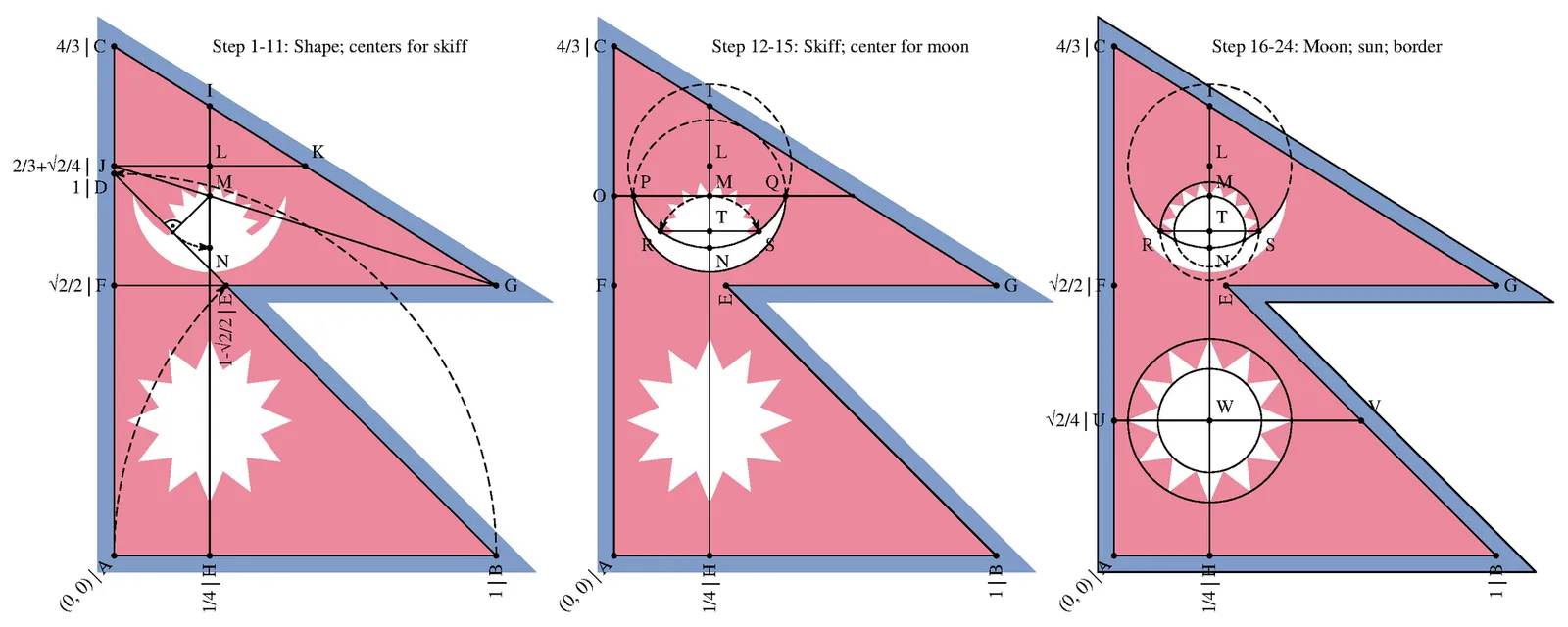
Look at almost any national flag and you'll see the same basic shape: a rectangle. Then there's Nepal. Its flag is the only national flag on Earth that isn't a rectangle or a square — two stacked crimson triangles, taller than they are wide — and by law it can only be drawn one way: with a compass, a straightedge, and eight numbered construction steps written directly into the country's constitution.
Key facts
- Nepal's flag is the world's only non-rectangular, non-square national flag among 195 UN member states.
- Its height-to-width ratio is an irrational number, roughly 1 : 1.21902 — it cannot be reproduced with a plain ruler alone.
- The current design was adopted 16 December 1962; its exact geometry is set out in Schedule 1 of Nepal's constitution.
- The two triangles represent the Himalaya; the moon and sun stand for the cool mountain climate and the heat of the southern lowlands.
The shape is not a design accident — it's a merger. For centuries, Nepali rulers and warlords flew triangular pennants rather than rectangular banners, a tradition traced back to King Prithvi Narayan Shah's unification campaigns in the 1700s. When the Rana family seized hereditary power as prime ministers in the mid-1800s, two rival branches of the dynasty each flew their own pennant — one bearing a moon, one bearing a sun, both originally shown with human faces representing the lunar and solar Rajput lines the Ranas claimed descent from. Rather than either branch dropping its symbol, the two pennants were stacked into a single double-pennon flag, moon above sun.
King Prithvi Narayan Shah's unification-era forces fly triangular battle pennants rather than rectangular flags.
Rival branches of the Rana dynasty each fly a pennant, moon and sun, complete with human faces; the two are stacked into one flag.
King Mahendra commissions engineer Shankar Nath Rimal to fix the flag's geometry by law; the faces are dropped from the sun and moon.
Nepal's new constitution reproduces the identical Schedule 1 construction diagram, unchanged.
What actually makes the flag mathematically unusual is the border. The plain red pennon shape on its own has tidy 3:4 proportions. Add the constitution-mandated blue trim running around every edge, though, and the outer proportions shift to an irrational ratio, roughly 1 : 1.21902 — a number with no exact fraction, produced by drawing a uniform-width border around two joined triangles instead of a rectangle. It is the only national flag whose legally official shape cannot be captured by a whole-number ratio.
The colours carry their own meaning. Crimson is Nepal's national colour and the colour of the rhododendron, the national flower that blazes across the mid-hills every spring trekking season. The blue border stands for peace. The moon in the upper triangle represents the cool, calm temperament of the high Himalaya; the twelve-rayed sun below stands for the intensity of the southern plains. Together, they're widely said to carry the wish that the nation itself endure as long as the sun and moon.
What this means for travellers
What this means for you
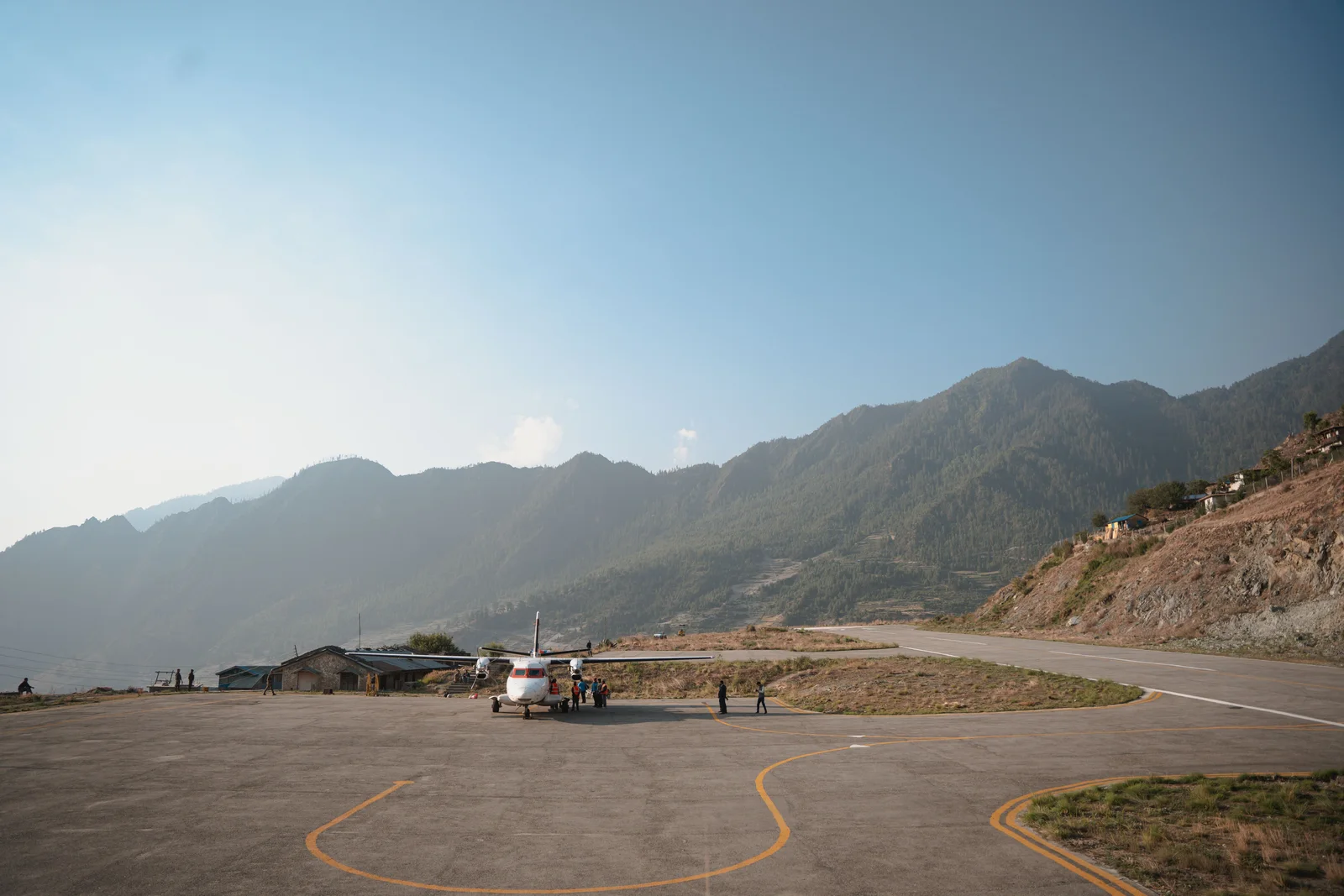
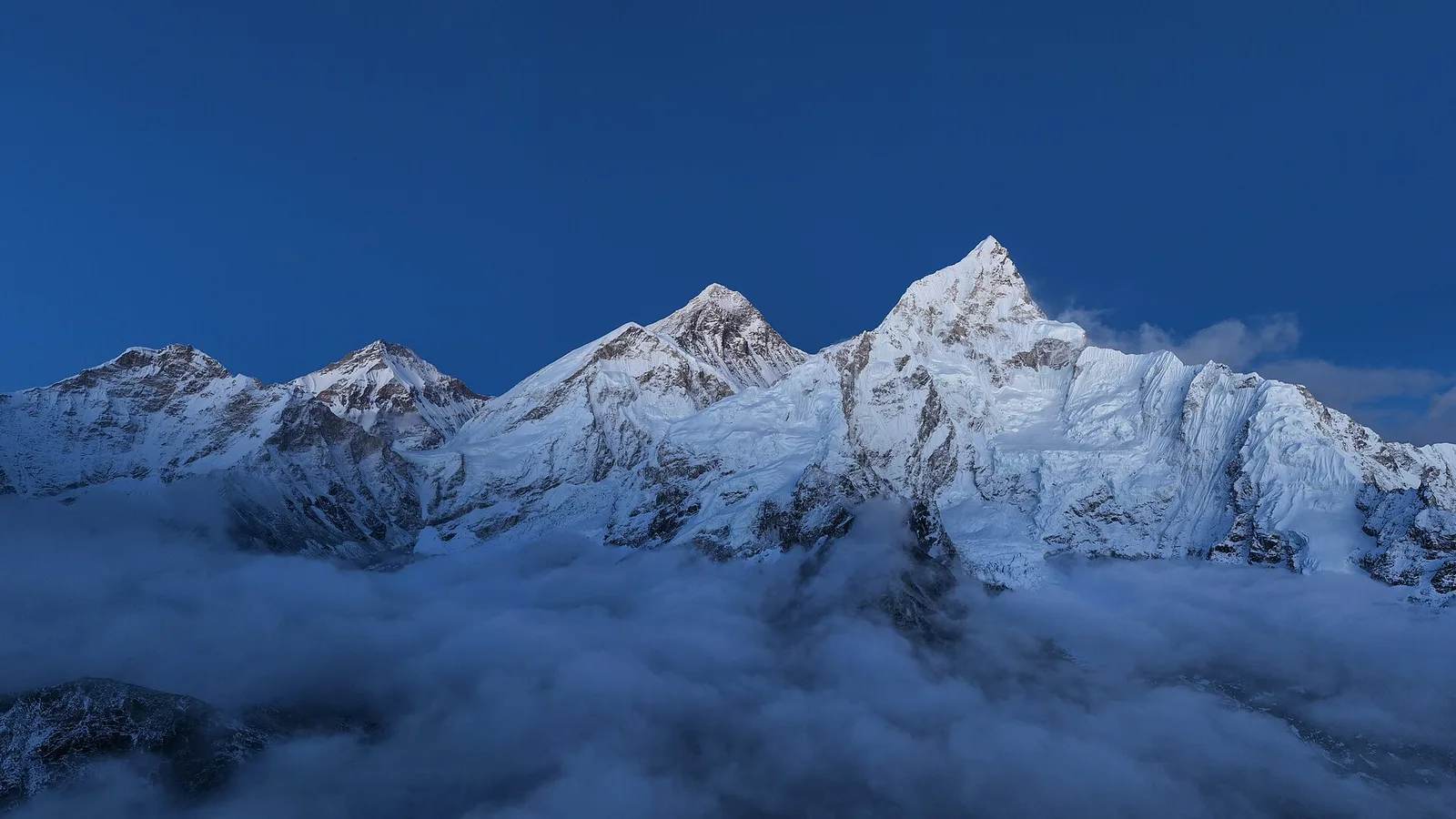
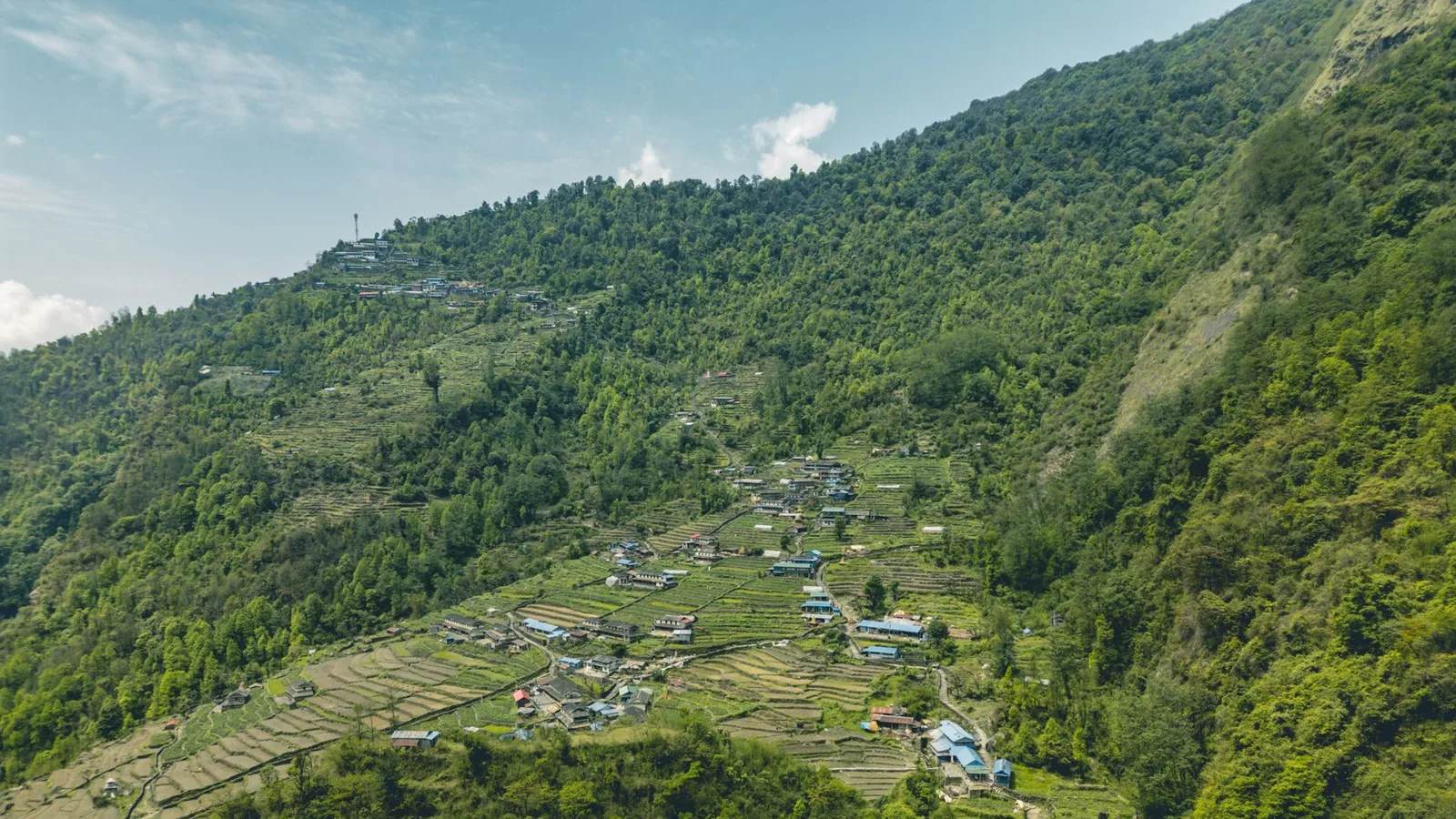
You'll see this flag everywhere on a Nepal trip, and now you'll know why it looks the way it does — snapping from a bamboo pole over a teahouse in the Khumbu, painted on a porter's jacket, strung above Kathmandu's Durbar Square, or planted on a summit ridge. It's a small, sharp reminder that Nepal never fully adopted anyone else's template for anything, including how a flag is supposed to be shaped. The same independence shows up in its mountains: nowhere else on the planet packs eight of the world's fourteen 8,000-metre peaks into one country.
Everest Base Camp and Annapurna Base Camp are the two treks most people picture when they imagine the Himalaya, while Ghorepani–Poon Hill is the short, high-reward version for a first trip. Start planning with Everest Base Camp or Annapurna Base Camp. Source: Flags of the World.
Cover photo: HorstGerhard via Wikimedia Commons (CC0). Section photos: CP Khanal via Pexels (Pexels licence); aaerux studio via Pexels (Pexels licence).
Still running this season
Everest Base Camp Trek — 15 Days is running normally
NMA-certified local guides, transparent pricing, 5,000+ treks since 1998. Message us your dates and we'll sort the permits, lodges and logistics — reply within 24 hours, no obligation.
Popular Nepal treks
All treks →
Related coverage

Breaking Safety & Advisories
Nepal’s tourism minister is asking you not to cancel your trek
Khadak Raj Paudel says the floods hit specific places, not the whole country, and the trails are open. Where he is right, and the bit he leaves out.
Records & People
Mount Everest's Official Height Was Wrong for 65 Years, Until Nepal and China Finally Agreed in 2020
The number on every map, 8,848.86 metres, only became official on 8 December 2020, after two countries spent over a decade measuring the same mountain and getting two different answers.
Records & People
Nobody Tells You Nepal's National Flower Turns Whole Mountainsides Crimson Every Spring
Nepal's national flower isn't grown in a garden bed — it's a forest tree that turns entire hillsides red for about six weeks a year, and the bloom climbs the mountain in a predictable wave.

Visas & Entry
Working Holiday Visas in 2026: How Under-30s Live and Work Abroad for a Year (Australia, NZ, Canada, UK)
The youth-mobility schemes that let young travellers live and work abroad for a year or two — the usual 18–30/35 age cap, which nationalities qualify for which country, and why the quota-capped ones run out.
Latest from the desk
Gear & Tech
Trail shoes or hiking boots, and what the ankle-support research actually found
Most teahouse trekkers wear more boot than the walk needs, and the ankle-support argument holding that up is thinner than the shops suggest.
Gear & Tech
Merino or synthetic base layers, and what a lab found when it measured the smell
Merino wins the week-long wear, synthetic wins the overnight dry, and the lab reason merino stays fresh is not the bacteria story you have been told.
Safety & Advisories
If someone you know is missing in the Nepal flood, you don't have to fly to Kathmandu
Nepal Police have identified 95 of more than 1,200 bodies recovered. Families abroad can be DNA-profiled at home and send the result in. Here is how it works.