
The only country with a non-rectangular flag, and the maths that fixes its shape
Nepal flies the only national flag that is not a rectangle. Its shape is set by a construction in the constitution, and the result is an irrational ratio.

At a glance
- Published · updated
- TopicRecords & People
- Verified againstWikipedia (Flag of Nepal); Encyclopaedia Britannica; Flags of the World
- Treks coveredEverest Base Camp Trek — 14 Days, Kathmandu Valley Cultural Tour — 3 Days, Nepal Classic Tour — 7 Days
Nepal flies the only national flag on Earth that is not a rectangle. It is two stacked crimson pennants with a blue border, taller than it is wide, and its exact shape is not drawn to a ratio at all: the constitution sets it out as a geometric construction, and the proportion that falls out of it is an irrational number.
Key facts
- The only non-rectangular national flag among the 195 sovereign states, and the only one taller than it is wide.
- Adopted in its current form on 16 December 1962.
- Its height-to-width ratio is irrational, about 1 : 1.219 — no whole-number fraction captures it.
- The moon shows 8 of its 16 rays; the sun has 12.
Why the flag is two pennants
Because it began as two separate flags. The double pennon combines individual pennants once used by rival branches of Nepal’s ruling dynasty, stacked into one rather than either branch giving up its symbol.
Pennant-shaped banners were the norm across the hill kingdoms long before the rectangle became the world’s default — a convention spread largely by European navies and colonial administrations. Nepal was never colonised, so nobody ever imposed the change, and the pennant shape simply stayed.
The shape is a construction, not a ratio
Nepal’s constitution does not give the flag’s proportions; it gives instructions for drawing it. Schedule 1 lays out a sequence of lines, arcs and measurements to be made with a compass and straightedge, and the shape appears as the result.
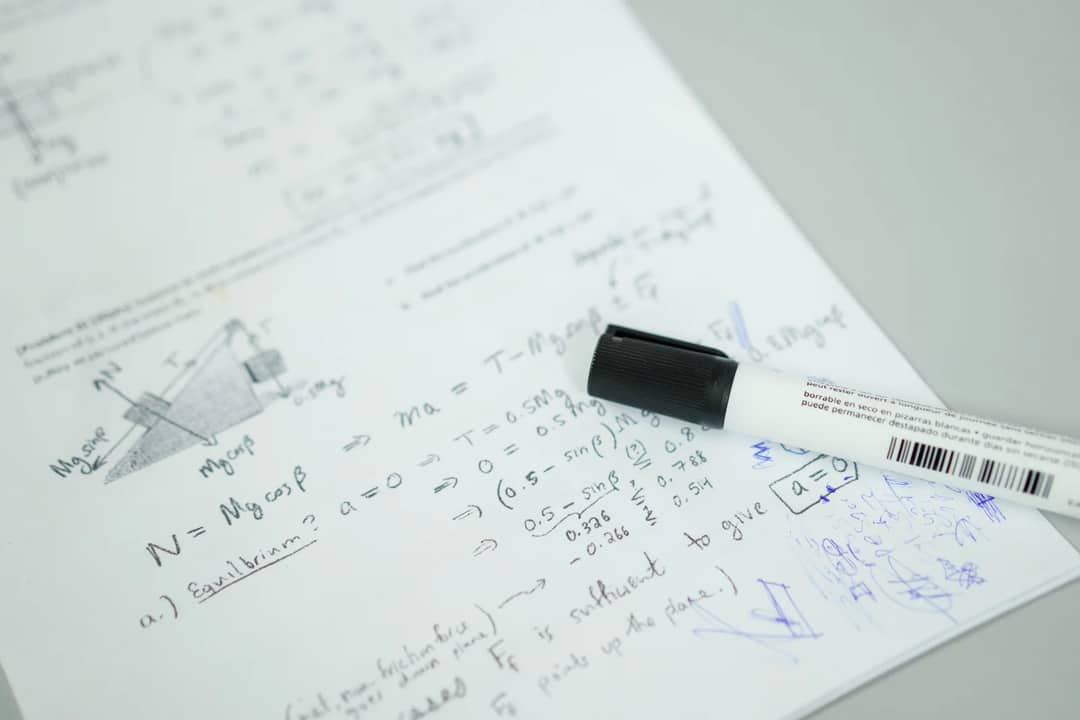
The geometry was fixed in 1962 by Shankar Nath Rimal, a civil engineer, at the request of King Mahendra. The inner red pennon has tidy proportions on its own; it is the uniform blue border running around two joined triangles that pushes the finished flag to about 1 : 1.21901 — a number with no exact fraction. An earlier version of our coverage gave the ratio as exactly 4:3. That describes part of the construction, not the finished flag, and we have corrected it.
| Element | What it is |
|---|---|
| Shape | Two stacked triangular pennants |
| Height : width | Irrational, about 1 : 1.21901 |
| Defined by | A geometric construction in Schedule 1 of the constitution |
| Field colour | Crimson — bravery, and the rhododendron, the national flower |
| Border | Blue — peace |
| Upper emblem | Moon, 8 of 16 rays visible |
| Lower emblem | Sun, 12 rays |
What the sun, moon and colours mean
The moon stands for peace and the cool of the Himalaya; the sun for hard work and the heat of the southern lowlands. Crimson is the colour of bravery and of the rhododendron that blazes across the mid-hills each spring, and the blue border stands for peace.
Early versions of both emblems had human faces; the 1962 standardisation dropped them for the clean shapes flown today. Nepalis have long read the pairing as a wish that the nation last as long as the sun and moon.
The flag the Olympics had to make an exception for
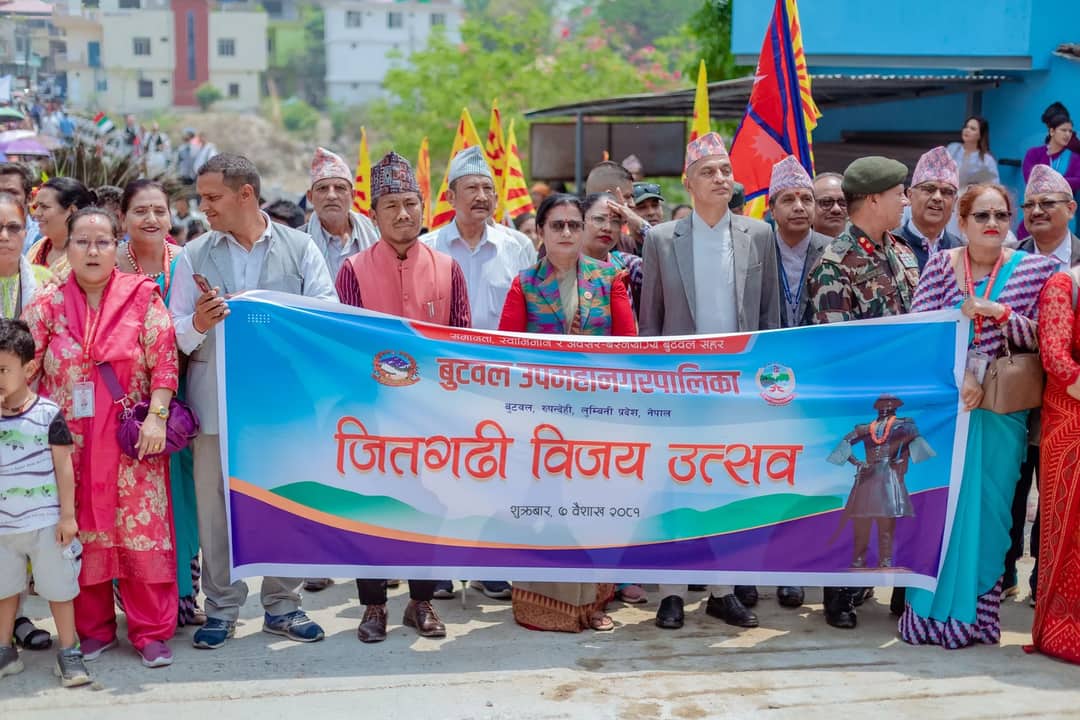
At Tokyo 2020 the protocol manual named Nepal as the only exception to the standard flag size. Every other flag was sized by a fixed rectangle; Nepal’s was required instead to match the others’ height, so it could hang level beside them.
It is a neat illustration of why flag makers find it awkward: mass-produced versions approximate the curves by eye, and it is common to see the sun or moon drawn slightly off. The government’s technical drawing remains the only fully authoritative version.
Rival branches of the ruling dynasty each fly their own pennon; the two are later stacked into one flag.
Engineer Shankar Nath Rimal standardises the geometry at King Mahendra’s request; the faces are dropped from the sun and moon.
The Tokyo 2020 protocol sizes Nepal’s flag by height so it sits level with every rectangle.
Of 195 sovereign states, Nepal remains the sole non-rectangular national flag.
How to spot it on a trek
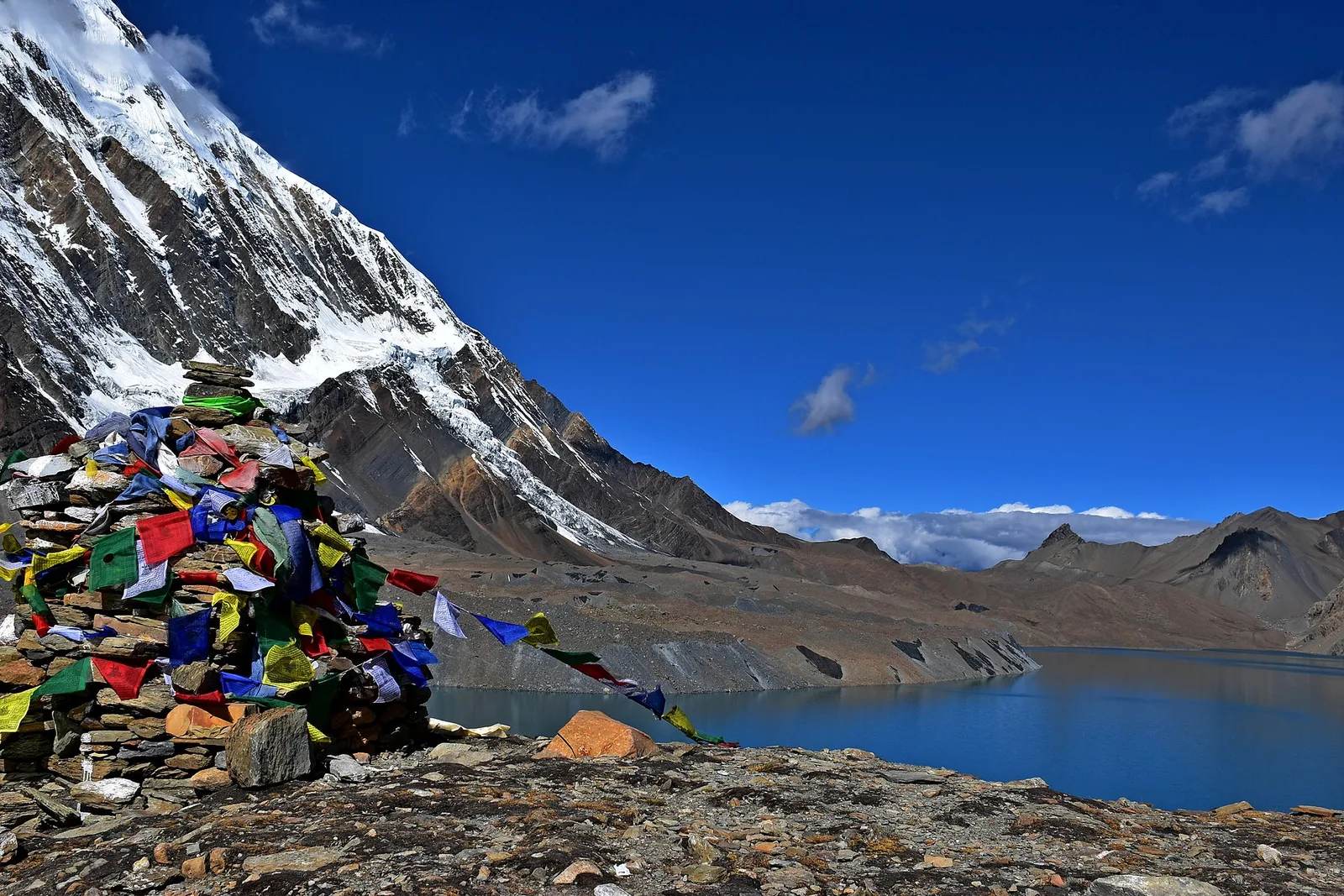
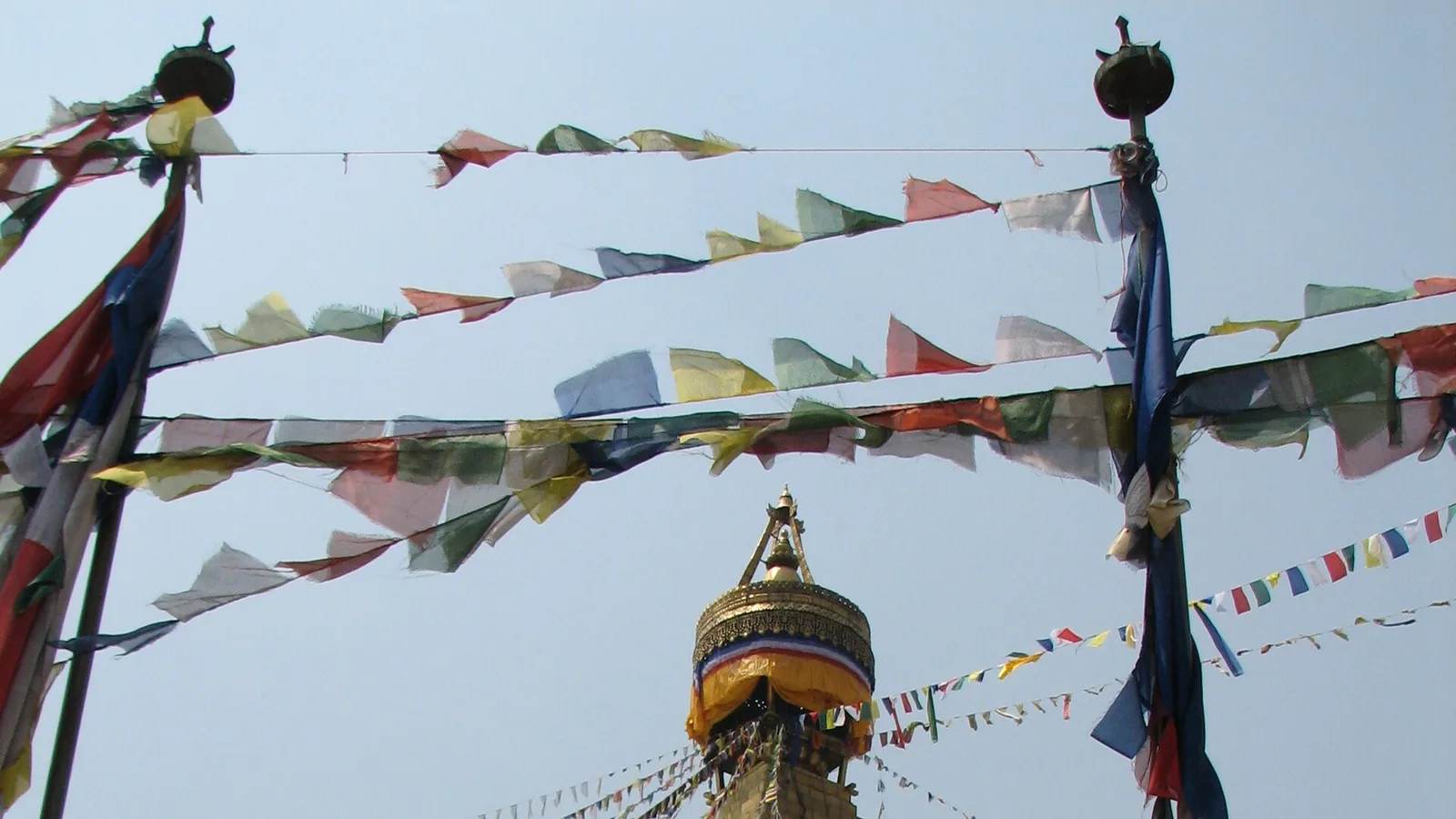
The national flag is crimson with a sun and moon; the strings of coloured squares over every pass are something else entirely. Those blue, white, red, green and yellow cloths are Tibetan Buddhist prayer flags — devotional, not national — and first-timers mix the two up constantly.
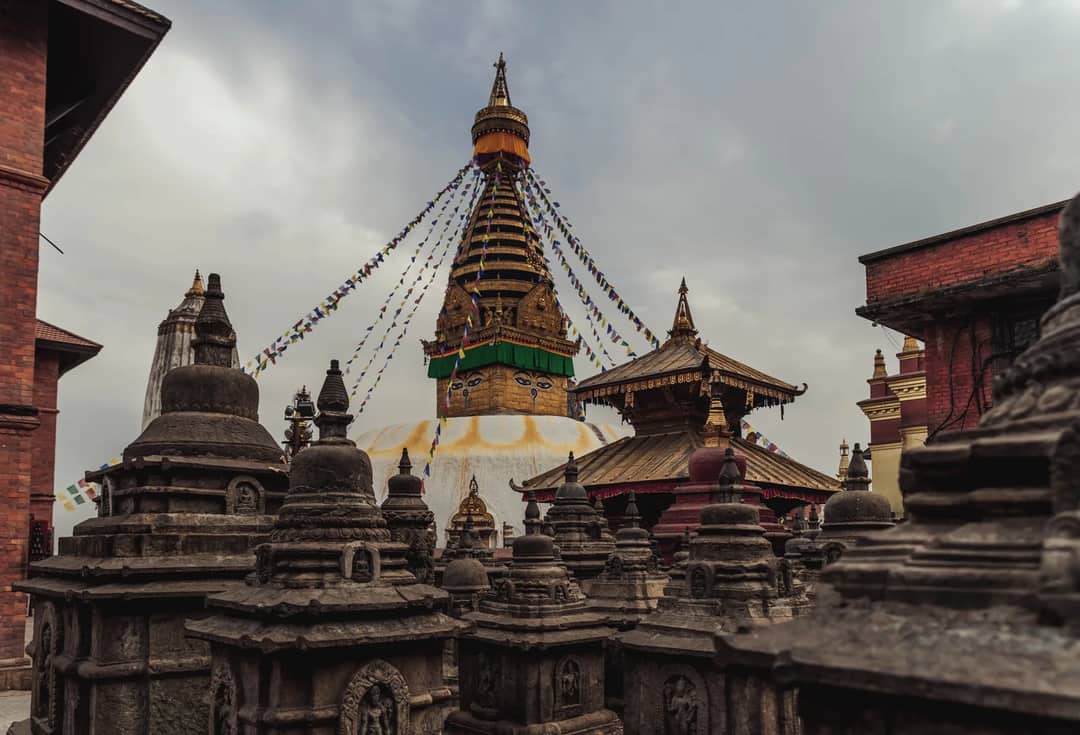
The real flag flies over government posts, army and police checkpoints and lodges, from Kathmandu’s Durbar Squares to Everest Base Camp. You pass beneath it at the permit checkpoint that marks the start of almost every trekking route in the country.
Six more ways Nepal stands alone
The flag is only the first way Nepal breaks the mould. Eight of the ten highest mountains on Earth stand in Nepal or on its borders; only K2 and Nanga Parbat, in Pakistan, break the run — with a caveat about the count we set out in the fourteen-versus-eight explainer.
The Buddha was born at Lumbini, in Nepal’s southern Terai, not in India. Nepal was never colonised. It runs on the Bikram Sambat calendar, so it is the year 2083 there, and it keeps a 45-minute time zone, UTC+5:45. And it spans roughly 60 metres above sea level to 8,848.86 metres at the top of Everest — one of three ways to call a mountain the tallest — inside a country about the size of England.
What this means for you
You will see this flag everywhere the moment you land, and now you will know why it looks the way it does. For the full story in person — the temples, the old royal squares, the living history behind those two pennants — our Kathmandu Valley Cultural Tour and Nepal Classic Tour spend real time in the plazas where it has flown for generations, and the Everest Base Camp trek takes you under it at every checkpoint on the way up.
Sources: Wikipedia, “Flag of Nepal” (ratio, 1962 standardisation, Tokyo 2020 protocol); Encyclopaedia Britannica, “Flag of Nepal”; Flags of the World.
Cover photo: CAPTAIN MEDUSA via Wikimedia Commons (CC BY-SA 4.0). Section photos: Atlantic Ambience via Pexels (Pexels licence); cottonbro studio via Pexels (Pexels licence); CP Khanal via Pexels (Pexels licence); Roman Saienko via Pexels (Pexels licence); Arjay Neyra via Pexels (Pexels licence).
Still running this season
Everest Base Camp Trek — 14 Days is running normally
NMA-certified local guides, transparent pricing, 5,000+ treks since 1998. Message us your dates and we'll sort the permits, lodges and logistics — reply within 24 hours, no obligation.
Popular Nepal treks
All treks →
Related coverage
Festivals & Events
If you are taking tika in the US this Dashain, the auspicious hours start on Tuesday night
Dashain’s tika day is Wednesday 21 October in Nepal. Across US time zones that window opens on Tuesday evening and closes before dawn.
Festivals & Events
Chhath 2026 in Nepal, the Terai’s sun-worship festival explained
Four days of fasting, river-standing and dawn offerings
Culture & Heritage
Nepal Culture & Heritage in 2026: Faiths, Peoples, Festivals and Living Traditions
A respectful overview of Nepal's cultural richness — its intertwined faiths, its mosaic of peoples, the UNESCO heritage of the Kathmandu Valley, and the great festivals and living traditions.
Culture & Heritage
What you’ll actually eat in Nepal, from dal bhat and momo to everything between
Dal bhat, momo and Nepal’s real food culture
Latest from the desk
Money & Insurance
How much Americans actually spend on a trip to Spain, against everyone else
€2,297 a head in 2025, the most of any country Spain’s statistics office reports and 65% above the average visitor. The British still spend more in total.
Breaking Safety & Advisories
Typhoon Dujuan Just Grounded 275 Flights Near Tokyo, Here's Whether You Should Still Fly to Japan This Week
Four dead, six missing and 275 flights cancelled as Typhoon Dujuan hit Tokyo, here's what the US, UK and Australia are actually telling travellers.
Visas & Entry
Australia Just Turned Your Second Working Holiday Year Into a Lottery, Here's How the Ballot Actually Works
A ballot for 45,000 second-year and 5,000 third-year places replaces automatic approval, announced by Australia's Home Affairs Minister on 17 September 2026.